Sourcing prototypes on Alibaba can save you money and connect you with thousands of suppliers, but it’s not without challenges. This guide simplifies the process, helping you avoid common pitfalls, verify suppliers, and manage costs effectively. Here’s what you’ll learn:
- Why Alibaba is a top choice: Access 200,000 suppliers, low MOQs, and Trade Assurance for payment protection.
- How to find reliable suppliers: Use targeted keywords, filter for verified manufacturers, and verify credentials like business licenses and certifications.
- Steps to success: Define your prototype requirements, request samples, and evaluate supplier performance.
- Avoiding risks: Spot red flags like trading companies posing as factories, vague communication, and hidden costs.
Alibaba offers flexibility for prototyping, but success depends on preparation, clear communication, and thorough supplier vetting. Follow these steps to transition smoothly from prototype to production while minimizing risks and costs.
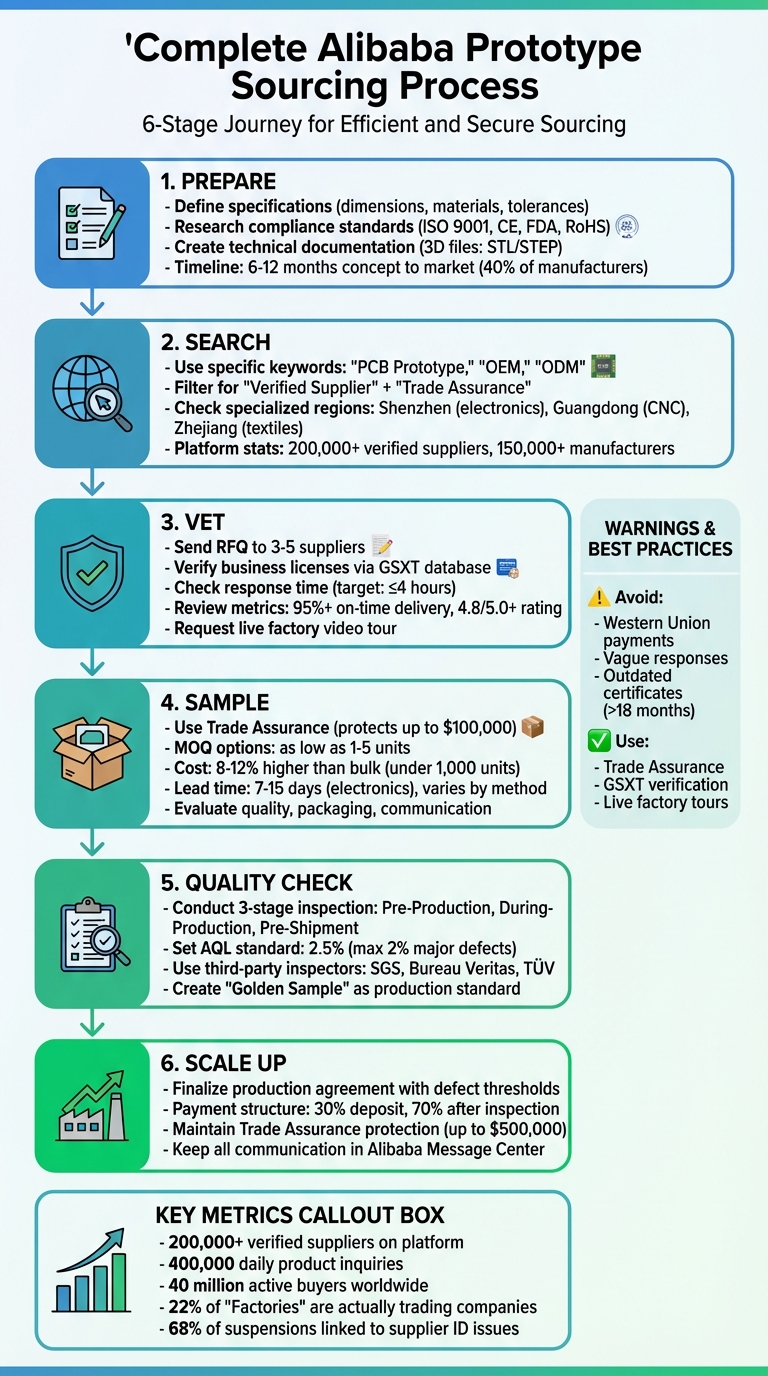
Complete Alibaba Prototype Sourcing Process: From Search to Production
Master Alibaba Sourcing: Step-by-Step Guide to Find the Perfect Supplier!
sbb-itb-633367f
Why Source Prototypes on Alibaba
Alibaba connects you to over 200,000 verified suppliers and 150,000 manufacturers across nearly every product category. Whether you need precision CNC machining from Dongguan or electronics assembly in Shenzhen, the platform’s extensive network has you covered. With 400,000 daily product inquiries from 40 million active buyers worldwide, Alibaba is the largest B2B marketplace for prototype sourcing. These numbers highlight why the platform is a go-to resource for efficient and reliable prototyping.
One standout feature is Alibaba's RFQ system, where you can submit detailed project specifications and receive competitive bids from multiple suppliers. This bidding process helps secure better pricing and faster delivery. Plus, Alibaba offers Trade Assurance, a free escrow service that ensures your payment is protected if the prototype doesn’t meet agreed quality standards or arrives late.
Starting small is easy. Many suppliers accept minimum order quantities (MOQs) as low as 5 units, and some even offer individual samples (MOQ of 1) for initial testing. This flexibility allows you to refine your designs without committing to large production runs. When you’re ready to scale up, most suppliers can seamlessly transition your project to mass production, making the process smooth from start to finish.
Benefits of Alibaba for Prototyping
One key advantage of Alibaba is the ability to communicate directly with factories. This means you can negotiate prices, customize technical details, and discuss manufacturing capabilities directly with suppliers. Cutting out middlemen gives you more control over the prototyping process.
Regional expertise is another perk. For example, Guangdong province (home to cities like Shenzhen and Dongguan) specializes in electronics and precision CNC machining, while Zhejiang is known for textiles and hardware. Many top suppliers in these regions boast on-time delivery rates exceeding 95%.
When comparing costs, small-batch prototyping is slightly more expensive per unit than mass production - typically 8–12% higher for runs under 1,000 units compared to those over 5,000 units. However, this approach often includes enhanced technical support during development. Some suppliers also refund sample fees when you place a bulk order, helping to offset initial costs.
Common Prototyping Methods Available
Alibaba suppliers offer a variety of prototyping methods tailored to different product types and timelines. For instance, precision CNC machining is ideal for creating metal and plastic parts quickly. Companies like Dongguan Bochuang Precision Manufacturing can respond to inquiries in under one hour. For electronics, PCBA (Printed Circuit Board Assembly) specialists like Zhongshan Huishine deliver prototypes in 7–15 days, making them a great choice for IoT and smart home products.
If your product involves plastic components, injection molding is a solid option. Suppliers such as Yubao (G.Z) Industrial Co., Ltd. can create custom molds for initial prototype runs and then use the same tools for mass production. For soft goods, suppliers like Shenzhen Levin Plush Toys Co., Ltd. provide quick responses - often within three hours - for custom plush and textile projects.
For faster concept testing, Alibaba’s "Ready-to-Ship" (RTS) category offers pre-made products that ship within 15 days and come with lower MOQs. This option is perfect for testing market demand before committing to custom designs. On the other hand, the "Customized" category connects you with factories that can build prototypes from scratch, offering full design control but with longer lead times and higher MOQs. These varied methods ensure you can define and refine your prototype exactly as needed.
Preparing Your Prototype Requirements
Before reaching out to suppliers, take the time to clearly define your prototype requirements. Ambiguous requests can lead to inefficient quotes and production delays. A formal specifications document not only demonstrates professionalism but also helps suppliers determine if they have the capability to produce your prototype effectively.
Include precise details like dimensions, weight, color, and materials. For textiles, specify whether you're using cotton, nylon, or blends. For hard goods, clarify raw material grades and finishes, such as matte, glossy, or textured surfaces. Don't forget technical parameters like tolerances, performance expectations, and functional features - these help suppliers gauge whether their machinery and expertise align with your needs.
Compliance standards are another crucial factor. Depending on your target market, identify certifications such as ISO 9001, RoHS, CE, FDA, or OEKO-TEX early on. As Fredrik Gronkvist, Co-founder of Compliancegate.com, explains:
"It's ultimately up to you as a buyer to clearly communicate all compliance requirements. This is not unique to buying from suppliers on Alibaba.com, but when you import products in general".
Suppliers rarely offer guidance on compliance, so it's essential to research and define these requirements before sending out your first Request for Quotation (RFQ). Once you have a clear understanding, draft detailed specifications to guide your search.
Specifications to Define Before Searching
Your specifications document should cover the following key areas:
- Physical attributes: Size, weight, and color.
- Material specifications: Fabric types or raw material grades.
- Technical parameters: Tolerances, performance benchmarks, and functional features.
- Branding and aesthetics: Logo placement, color schemes, and surface finishes.
- Packaging and logistics: Packaging type, labeling, and shipping destination.
- Compliance standards: Certifications like ISO 9001, CE, FDA, etc..
Also, include your target price per unit and the Minimum Order Quantity (MOQ) needed for initial testing. Clearly defined order constraints make it easier to evaluate suppliers and ensure accurate quotes. Keep in mind that bringing a new product from concept to market typically takes six to 12 months for about 40% of manufacturers, so plan your timeline accordingly.
Preparing Technical Documentation
Once your requirements are finalized, create detailed technical documentation to avoid miscommunication with suppliers. Accurate quotes depend on clear, comprehensive designs. Provide 3D modeling files in formats like STL or STEP, along with detailed 2D drawings and descriptions. These files help manufacturers assess production feasibility and identify potential challenges before you commit.
When submitting an RFQ on Alibaba, attach these files directly. Supplement your request with photos of existing prototypes or reference videos to further improve quote accuracy. Be sure to include compliance certifications in both your specifications and technical documents to confirm the supplier meets regulatory standards. The more information you provide upfront, the fewer issues you'll face later. As Joel T. Gaucher from Flapen points out:
"Not every supplier is a factory. Not every quote is real. And not every product is FBA-ready".
Thorough documentation not only ensures accurate quotes but also helps you identify reliable manufacturers and filter out resellers who may not deliver on your expectations.
How to Find Prototype Suppliers on Alibaba
When you're ready to search for prototype manufacturers on Alibaba, having clear specifications and technical documentation is crucial. With over 200,000 manufacturers and suppliers and more than 200 million products listed on the platform, the challenge lies in identifying those with expertise in prototyping and quality assurance.
Start by distinguishing between OEM (Original Equipment Manufacturer) and ODM (Original Design Manufacturer) suppliers. Use "OEM" in your search if you're looking for product modifications, and "ODM" if you need completely custom designs. This step helps filter out suppliers who may not have the design capabilities required for your prototype.
Search Keywords That Work
Generic terms like "plastic parts" or "electronics" often yield thousands of irrelevant results, including trading companies and sponsored ads. Instead, use specific keywords that align with your prototype's technical needs. For instance:
- For technical products: "PCB Prototype", "Custom PCB Boards", or "Digital Prototyping".
- For physical products: Combine the material with terms like "prototype" or "custom manufacturing", such as "silicone prototype molding" or "3D printing service China."
Switch the dropdown to "Suppliers" and use industry-specific terms like "precision machining" or "injection molding" to narrow your results to specialized manufacturers. Once you find potential matches, check their "Main Products" list. A focused range of 3 to 12 related products often indicates a specialized manufacturer rather than a trading company reselling others' work.
You can also try Alibaba Lens, an image search tool that lets you upload a photo or sketch of your prototype. This feature is particularly useful for finding manufacturers capable of producing designs with unique shapes or aesthetic features.
Filtering for Reliable Suppliers
After refining your list, use Alibaba's built-in filters to identify trustworthy suppliers. Select "Verified Supplier" and "Trade Assurance" to focus on businesses that have undergone third-party audits and offer payment protection. Verified Suppliers are assessed by organizations like SGS, Bureau Veritas, or TÜV, ensuring they meet standards for production capabilities and quality control.
Check performance metrics on supplier profiles. For example, Yubao (G.Z) Industrial Co., Ltd. demonstrates operational reliability with an average response time of ≤2 hours and an on-time delivery rate of 99.7%. Metrics like these can help you gauge a supplier's reliability and customer focus.
Look for suppliers with at least five years of experience on the platform. As Alibaba Reads points out:
"A longer business history usually translates to having a solid manufacturing process and strict quality assurance systems".
Additionally, consider the supplier's location. Certain regions in China specialize in specific industries: Shenzhen and Dongguan for electronics and CNC machining, Zhejiang for textiles and hardware, and Jiangsu for heavy machinery and precision engineering.
For a more streamlined approach, consider using ForthSource, a platform that aggregates suppliers and assigns a Trust Score (0 to 100) based on verified licenses, transaction data, and reviews. This tool eliminates sponsored ads and unverified listings, giving you a clearer picture of your options. Premium members ($29/month) can also access a Real-Time Landed Cost Calculator to estimate shipping, duties, and taxes - helping you compare the total cost of prototyping, not just the unit price.
Vetting and Evaluating Suppliers
Once you've narrowed down your list of potential suppliers, the next step is to carefully vet them. A 2026 audit found that 22% of suppliers labeled as "Factories" were actually trading companies. Additionally, supplier ID discrepancies were linked to 68% of high-risk merchant account suspensions in 2025. Properly vetted suppliers are key to avoiding costly issues, like prototype failures.
Requesting Quotes and Sample Information
Start by sending a well-structured Request for Quotation (RFQ) to 3–5 pre-vetted suppliers. This approach keeps the process manageable while encouraging competition. Your RFQ should include all the essentials: technical specifications, target quantities (even if it's just one prototype), delivery requirements, payment terms, and a clear timeline for decisions. Using a standardized spreadsheet can help you easily compare unit prices, volume discounts, lead times, and total costs.
Ask targeted questions to gauge the supplier's expertise. For instance, inquire about their quality control processes, material sourcing, and production scalability. Reliable manufacturers typically provide detailed technical information - like CNC repeatability tolerances or material tensile strength - within 24 hours. As Li Wei, Senior Sourcing Director at Global Retail Alliance, notes:
"Manufacturing confidence shows up in speed and specificity."
If responses are vague or delayed, consider it a warning sign.
Always request samples before placing larger orders. Use this phase to evaluate the product itself, as well as factors like shipping times, packaging quality, and the supplier's communication style. For high-stakes prototypes, you might even request a live video tour of their production line via Zoom or WeChat. This can confirm that the supplier owns the equipment and isn’t outsourcing the work to another factory. Once you’ve collected sample data and quotes, focus on verifying the supplier’s credentials for long-term reliability.
Verifying Supplier Credentials
Badges like "Verified Supplier" or "Assessed Supplier" indicate that third-party agencies such as SGS, TÜV Rheinland, or Bureau Veritas have audited the supplier's operations. However, these audits represent a single point in time. Always download the full assessment report and check its date. If it’s older than 18 months or heavily redacted, treat the supplier as unverified.
You can also cross-check business licenses through China's National Enterprise Credit Information Publicity System (gsxt.gov.cn). By entering the supplier’s Unified Social Credit Code, you can access details like their registered capital, legal status, and any administrative penalties. For example, in early 2026, Maya, the founder of Lumina Home, faced a $247,000 liability after sourcing smart lighting kits from a supplier whose credit code belonged to a company liquidated in 2022. The supplier’s forged CE certificates led to her inventory being seized by EU customs. Rafael Chen, Head of Compliance at Global Fulfillment Alliance, emphasizes:
"Verification isn't bureaucracy - it's risk transfer. In 2026, your supplier's ID is your contract with regulators."
For a quicker process, platforms like ForthSource assign Alibaba suppliers a Trust Score (0–100) based on verified business licenses, transaction volume, response rates, and customer reviews. Enterprise users ($99/month) can also access Baidu Intelligence Reports, which leverage domestic data sources to confirm a factory’s legitimacy within China - an invaluable tool for high-volume orders.
| Performance Metric | Target Benchmark |
|---|---|
| Response Time | ≤ 4 hours |
| On-Time Delivery Rate | ≥ 95% |
| Reorder Rate | ≥ 30% |
| Review Score | ≥ 4.8 / 5.0 |
Finally, verify any certifications the supplier claims to hold. Don’t just rely on profile icons - ask for specific certificate numbers for standards like ISO 9001, CE, or FDA compliance. Cross-check these numbers with the issuing organization’s public registry to confirm their validity.
Ordering and Managing Prototype Samples
Once you've reviewed supplier quotes and chosen a vendor, it's time to place your sample order. This stage is critical - it lets you test the supplier's performance before committing to large-scale production. By protecting your payment and carefully assessing the prototype, you can avoid costly mistakes. Here's how to safeguard your sample orders using Trade Assurance and evaluate the quality of your prototypes effectively.
Using Trade Assurance for Sample Orders
When ordering samples, always opt for Alibaba's Trade Assurance service. This acts like an escrow system, holding your payment until you confirm the prototype matches your specifications. Corey Ferreira from Shopify puts it simply:
"Trade Assurance is Alibaba's escrow service. It holds your payment and only releases it to the supplier once you confirm satisfactory receipt of your order."
This service protects you from issues like subpar quality, delayed shipments, or payment fraud. In 2026, Alibaba introduced real-time logistics tracking with carriers like DHL and Maersk. If no pickup scan occurs within 72 hours of the scheduled dispatch, the system escalates the matter to mediation automatically. This update has cut dispute resolution times from 19 days in 2024 to just 6.3 days.
To ensure you're covered, filter for suppliers who accept Trade Assurance payments. Always use Alibaba's supported payment methods - credit cards, Apple Pay, or Google Pay - and avoid unprotected options like Western Union or direct wire transfers. Keep all communication within Alibaba's Message Center to maintain full protection.
When placing your sample order, include detailed documentation, such as tolerances, defect thresholds, and material requirements (e.g., tensile strength or Pantone color codes). This appendix is vital if a dispute arises. Trade Assurance typically covers orders for 30 days after delivery. For U.S. buyers, defective prototypes can be returned locally at no extra cost, and the service protects transactions up to $100,000.
Once you've secured payment protection, the next step is to thoroughly evaluate the prototype.
Evaluating Prototype Quality
A detailed quality check ensures the prototype aligns with your technical and compliance standards. Start by verifying its dimensions, materials, and color accuracy. Then, test its functionality to uncover any design flaws or safety concerns.
Examine the craftsmanship closely. Look for issues like loose threads, uneven seams, poor finishes, or structural weaknesses. Additionally, confirm the prototype complies with your target market's standards - such as CE for the EU, FDA for the U.S., or RoHS for electronics. Always cross-check certifications with the issuing organization's public registry.
Packaging is another key factor. Assess whether it can withstand international shipping and compare the delivery timeline to the supplier's initial promise.
When giving feedback, visual annotations can save time and prevent misunderstandings. Use photos with arrows, circles, or text overlays to highlight areas needing improvement. As Dave Bryant, an e-commerce sourcing expert, advises:
"A picture is worth a thousand words and when it comes to sourcing, a picture can be worth a thousand fewer headaches."
Be as specific as possible. For example, instead of saying "heavy-duty", define exact material types, hardware specifications (like zippers or brackets), and packaging details. Keep all feedback within Alibaba's Message Center, and for complex revisions, request a video call with the production manager to clarify technical details.
If major changes are required, always request a second sample before moving to mass production. Once you're satisfied, designate one prototype as the "Golden Sample" - the standard for production quality. Many suppliers will deduct the sample cost from your bulk order, so negotiate this upfront.
For reference, consider metrics like those from Yubao (G.Z) Industrial Co., Ltd., a Guangdong-based manufacturer. As of February 2026, they achieved a 99.7% on-time delivery rate and a 37% customer reorder rate. Such data can help you gauge your supplier's reliability.
Transitioning to Mass Production
Once your prototype has passed evaluation, scaling up to mass production requires careful planning. Rushing through this phase can lead to defects, delays, and disagreements with suppliers. To avoid these pitfalls, focus on thorough agreements and integrated quality checks.
Finalizing Production Agreements
A well-drafted production agreement sets clear expectations and safeguards both sides. Start by documenting every detail from your approved Golden Sample - this includes technical specs, materials, packaging designs, and color codes. The Golden Sample serves as your benchmark for production quality.
Define quality standards in measurable terms. For instance, instead of vague language, specify a defect rate below 0.5%. This provides clear criteria for acceptance or rejection. Your agreement should also cover on-time delivery rates (targeting above 98%), response times (within 24 hours), and acceptable defect thresholds.
Payment terms should align with production milestones. A common structure is a 30% deposit to initiate manufacturing, progress payments during production, and the remaining 70% after a third-party inspection confirms quality. Avoid releasing full payment before verifying the goods meet your standards.
Address intellectual property ownership upfront. If your supplier contributed to custom designs, formulas, or tooling, clearly state who owns these assets to prevent disputes down the line. Also, define shipping responsibilities using Incoterms like DDP or FOB to clarify who handles freight, insurance, and customs costs.
Include a termination clause outlining what constitutes a breach of contract and your exit strategy. Adding a "cure period" allows the supplier time to address quality issues before you terminate the agreement. This approach protects your interests while maintaining the relationship.
Verify the supplier's production capacity with a live video tour of their factory floor to confirm they’re the actual manufacturer, not a middleman. Focus on suppliers located in specialized industrial hubs (like Shenzhen for electronics) where access to resources and expertise is stronger.
Once agreements are in place, shift your attention to quality control during production.
Implementing Quality Control Measures
With agreements finalized, strong quality controls are essential to ensure production integrity. Quality control works as a safety net, identifying problems through inspections after production begins.
Plan for inspections at multiple stages: raw materials, mid-production (20% to 50% completion), and pre-shipment (80% to 100% finished). This approach helps catch issues early, preventing them from affecting the entire batch.
Use acceptance sampling to evaluate a representative batch against an AQL (Acceptable Quality Limit) of 2.5%, ensuring fewer than 2% major defects. Since inspecting every item isn’t feasible, statistical sampling checks a random selection.
For pre-shipment inspections, hire third-party agencies like SGS, Bureau Veritas, or TÜV. These inspectors provide unbiased reports to confirm your goods match the Golden Sample. As Kanary Solutions cautions:
"A common tactic: perfect hand-assembled samples, then mass production uses cheaper materials and looser tolerances. Only third-party QC inspections catch this."
Never release the final payment until the inspection passes.
If you’re sourcing through Alibaba, consider using Trade Assurance. This service protects payments up to $500,000 by holding funds in escrow until you confirm the goods meet your specifications and arrive on time. If defects exceed the agreed threshold or shipments are delayed, you’re eligible for a refund within 30 to 60 days of delivery.
Before approving the full production run, request a pre-production sample from the mass production line. This ensures the factory can replicate your prototype at scale. If issues arise, apply the "5 Whys" method - asking "Why?" five times to uncover and address the root cause before continuing.
To maintain Alibaba’s Trade Assurance protections, keep all communications and documentation within their Message Center. This creates a clear paper trail in case disputes arise.
Common Mistakes to Avoid
Sourcing prototypes on Alibaba can quickly derail your budget and timeline if you miss key warning signs or fail to calculate costs accurately. Steering clear of these mistakes is crucial to maintaining both quality and financial control throughout the process.
Warning Signs in Supplier Profiles
Spotting potential issues early can save you from costly setbacks. One of the first things to check is product specialization. Reliable factories usually focus on 3 to 12 core categories that match their equipment and expertise. If a supplier lists a wide range of unrelated products - like electronics and yoga mats - they’re likely a trading company. These intermediaries often add markups of 22% to 37% over factory rates.
Pay attention to mismatched business details. For example, a company named "Garment Co." selling jewelry, or a supplier claiming 15 years of experience but showing a business license registered within the last six months, should raise red flags. A startup once suffered significant financial losses due to poor-quality products from a supplier with misleading credentials.
Communication delays are another warning sign. Suppliers who take more than two hours to respond or provide vague technical details often indicate future issues with quality and delivery. As Li Wei, Senior Sourcing Director at Global Retail Alliance, explains:
"Suppliers who hesitate to share factory footage or delay technical answers aren't hiding capacity - they're revealing process gaps."
You should also scrutinize documentation. Look out for redacted audit reports, outdated certificates (older than 18 months), or ISO certifications from non-accredited organizations. Research shows that many Alibaba suppliers falsely present themselves as factories, with only 37% of active Gold Suppliers displaying fully updated third-party verification timestamps.
Be cautious of payment methods. Suppliers who push for payments via Western Union, direct wire, or external escrow sites often pose a fraud risk. In February 2024, Maria Chen, founder of Lumina Home, lost $47,000 after bypassing Alibaba’s Trade Assurance for a custom LED mirror order. The supplier used a fake domain (everbright-smartbuy.com) and a deepfake video call to simulate a factory tour. Since the payment went directly to a Cambodian account, recovery was impossible.
To verify authenticity, use reverse-image searches on product photos and request live video tours of the production line. Ask suppliers to show government-issued IDs and confirm their business licenses through China’s National Enterprise Credit Information Publicity System (gsxt.gov.cn). This system allows you to check registered capital and any penalties.
Identifying these red flags is critical, but understanding the full cost of your order is just as important.
Calculating Total Costs Accurately
Even when a supplier appears trustworthy, overlooking hidden costs can lead to unexpected expenses. The unit price listed on Alibaba is just the baseline. To get the full picture, factor in shipping fees, import duties, VAT, customs clearance, handling charges, mold development, certifications, third-party inspections, and currency exchange fluctuations.
Prototype costs are often 3 to 10 times higher per unit compared to mass production due to limited economies of scale. For example, mold development alone can exceed $10,000. Certifications like FDA approval range from $300 to $400, while MSDS certification for air transport batteries can cost $3,000 to $4,000. Third-party inspections typically cost about $100 per day. Currency exchange fluctuations can also affect large orders, so consider using currency tracking tools or forward contracts to lock in favorable rates.
Daniel Harper from Alibaba Product Insights highlights this point:
"The listed price in an Excel template may only reflect the base product cost. Additional fees - such as shipping, import duties, VAT, customs clearance, and handling charges - can significantly increase the final price."
For simplicity, some buyers opt for Delivered Duty Paid (DDP), where the seller handles shipping, customs, duties, and taxes. However, this approach contributed to 62% of freight disputes in 2023.
Always ask suppliers for a detailed cost breakdown to uncover hidden fees like handling or documentation charges. Tools like ForthSource’s Real-Time Landed Cost Calculator (available for $29/month to Premium members) can help estimate air, sea, and express shipping rates to the U.S., along with applicable duties and taxes. This allows you to understand the full cost before committing to a supplier.
Lastly, send a Request for Quotation (RFQ) to multiple suppliers to establish a benchmark for manufacturing costs. In many cases, suppliers may agree to refund the higher sample development costs once a bulk order is placed. Using live price data can also help businesses adapt 30% to 50% faster to supply chain changes.
Conclusion
Sourcing prototypes on Alibaba requires careful planning and thorough verification to ensure success. Begin by clearly defining your technical specifications - materials, tolerances, and performance benchmarks. This level of detail helps suppliers provide accurate bids and minimizes the risk of receiving samples that don’t meet your needs.
Don’t rely solely on platform badges like "Gold Supplier" or "Trade Assurance." Instead, dig deeper. Use China's GSXT database to verify Business Registration Numbers and confirm that your supplier is an active manufacturer, not just a trading company. Request live video tours of production facilities and conduct technical evaluations. As Li Wei, Director of Global Sourcing Intelligence at Asia Procurement Alliance, explains:
"Suppliers invest heavily in Alibaba storefronts - but very little in backend compliance. In 2026, the strongest signal isn't 'Gold Supplier' or 'Trade Assurance.' It's whether they proactively share their production capacity utilization rate and raw material traceability logs".
Adopt a three-stage sampling approach to ensure quality: Pre-Production Samples (PPS), During-Production Samples (DPS), and Pre-Shipment Inspection (PSI). These steps help identify and address issues before committing to bulk production. Keep all communication within Alibaba’s Message Center to maintain Trade Assurance protections, and include contractual safeguards like defect thresholds and tooling ownership clauses in your agreements.
Finally, focus on achieving full cost transparency. Account for all expenses, including shipping, duties, customs clearance, mold development, and certifications, to avoid unexpected costs. Tools like ForthSource’s Real-Time Landed Cost Calculator ($29/month for Premium) can help estimate air, sea, and express shipping rates to the U.S., along with applicable import duties and taxes. With these measures in place, you can confidently transition from prototype to production.
FAQs
How can I find reliable suppliers on Alibaba and avoid trading companies?
To identify trustworthy suppliers on Alibaba while steering clear of trading companies, focus on suppliers with verified business licenses and Trade Assurance status. These markers indicate that Alibaba has already conducted some level of vetting. Additionally, check their transaction history and customer reviews to get a sense of their reliability and professionalism.
Take it a step further by conducting your own research. Pay close attention to how they communicate - reliable manufacturers typically provide clear, detailed, and consistent information about their production processes, materials, and lead times. To ensure product quality, request samples before committing to a larger order. This extra step can save you from potential issues down the line.
How can I protect my payment and ensure the quality of prototypes on Alibaba?
To protect your payment and guarantee the quality of your prototype, it’s essential to work with verified suppliers. Tools like ForthSource can help you identify trustworthy factories by evaluating their Trust Scores, which are based on transaction history, reviews, and credentials. If you’re using Alibaba, look for suppliers with badges like "Verified Supplier" or "Gold Supplier", but don’t skip your own research - always perform thorough due diligence.
Make use of Alibaba’s Trade Assurance service to add an extra layer of protection. This service holds your payment in escrow until you confirm that the prototype meets your standards. Clear communication with suppliers is key - ask for detailed explanations of their quality control procedures and request samples before committing to larger orders.
For even greater security, stick to secure payment methods, such as Alibaba’s escrow system, and think about hiring third-party inspection services. These services can verify the prototype’s quality before you finalize payment. By following these steps, you can reduce risks and ensure a smoother sourcing process.
How can I calculate the full cost of sourcing prototypes on Alibaba?
To figure out the total cost of sourcing prototypes on Alibaba, it's important to consider every expense involved. This includes design and development costs, sample fees (which are typically higher than the costs for mass production), as well as manufacturing expenses like molds and any necessary certifications or testing.
You'll also need to account for shipping costs, import duties, and taxes, along with other potential expenses such as warehousing, quality inspections, and local transportation. For a more accurate estimate of shipping and import fees, tools like ForthSource’s landed cost calculator can be incredibly helpful. This way, you can get a better understanding of the full cost before reaching out to suppliers.