Buying from Alibaba? Verification is critical. Misrepresentation by suppliers is rampant - 22% of suppliers claiming to be factories are actually trading companies, inflating costs by 22-37%. Fake certifications, subpar materials, and payment fraud are common risks. For example, a hardware startup lost months due to defective stainless steel hinges from a supplier with forged documents.
Here’s how to protect yourself:
- Check business licenses on official Chinese databases (e.g., gsxt.gov.cn).
- Verify certifications (e.g., ISO 9001) with issuing bodies.
- Inspect factories via third-party audits or live video tours.
- Order samples through Alibaba’s Trade Assurance for secure handling.
- Use Alibaba badges wisely: Gold Supplier confirms basic checks, but Verified or Assessed Supplier offers deeper scrutiny.
- Leverage tools like ForthSource for quick risk assessments and cost calculations.
Key takeaway: Don’t rely solely on Alibaba’s verification badges. Conduct thorough due diligence to avoid fraud, quality issues, and middlemen markups.
🔥 Alibaba Supplier Verification: Avoid Scams & Find Trusted Suppliers (Step-by-Step Guide!)
Alibaba's Verification Programs Explained
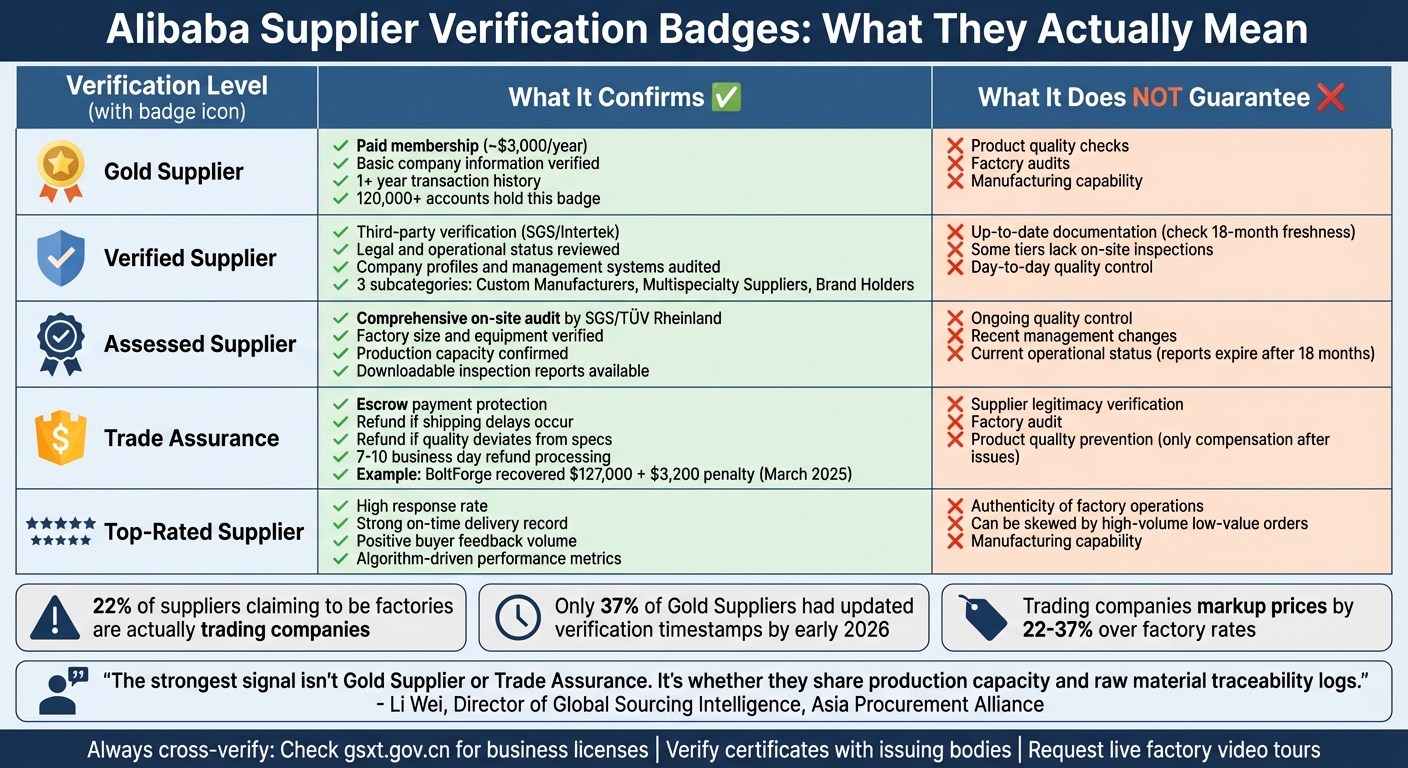
Alibaba Supplier Verification Badges Comparison Guide
Alibaba provides several verification programs to help buyers identify legitimate suppliers, with each badge offering distinct assurances. Understanding the scope of these badges is crucial to avoid costly mistakes. By early 2026, only 37% of active Gold Suppliers displayed fully updated verification timestamps, suggesting many badges may be outdated or incomplete.
The platform's verification system relies on third-party auditors like SGS, TÜV Rheinland, Intertek, and Bureau Veritas. These organizations conduct both online document reviews and physical factory inspections to validate a supplier's legal status, production capabilities, and operational claims. However, even the most thorough audits represent a specific moment in time and do not ensure ongoing quality control. Below is a breakdown of the key verification badges and what they do - or don't - guarantee.
What Each Verification Badge Means
Gold Supplier is the most common badge, held by over 120,000 accounts on Alibaba. This paid membership (approximately $3,000 USD per year) confirms basic identity checks and at least one year of transaction history. However, it does not include product quality checks or factory audits.
Verified Supplier involves a more detailed review. Third-party institutions like SGS or Intertek perform extensive audits covering company profiles, management systems, production capabilities, and process controls. By 2026, Verified Suppliers were further categorized into three types: Custom Manufacturers (specialized in custom goods), Multispecialty Suppliers (offering a broad range of products with lower minimum order quantities), and Brand Holders (authorized distributors). These categories help buyers quickly identify suppliers that match their specific sourcing needs.
Assessed Supplier represents the highest level of scrutiny. It includes comprehensive on-site audits conducted by firms like SGS or TÜV Rheinland to verify factory size, equipment, and production capacity. Buyers can download these reports by navigating to "Product details" > "Company profile" > "Factory inspection reports." However, any audit report older than 18 months should be treated as outdated, as factory conditions and ownership can change quickly.
Trade Assurance is not a verification badge but a buyer protection program. It acts as an escrow service, ensuring refunds if suppliers fail to meet shipping deadlines or if product quality significantly deviates from agreed specifications. Refunds are generally processed within 7–10 business days after a dispute is validated. For example, in March 2025, BoltForge, a hardware startup based in Portland, recovered $127,000 plus a $3,200 penalty using Trade Assurance after their supplier delivered substandard hinges. Further investigation revealed forged ISO certificates through China's GSXT database.
Top-Rated Supplier is an algorithm-driven badge based on metrics like response rate, on-time delivery, and buyer feedback volume. While it reflects strong platform performance, it can be skewed by high-volume, low-value orders and does not confirm the legitimacy of factory operations.
| Verification Level | What It Confirms | What It Does Not Guarantee |
|---|---|---|
| Gold Supplier | Paid membership; basic company information verified | Product quality checks or factory audits |
| Verified Supplier | Third-party verification of legal and operational status | Up-to-date documentation; some tiers lack on-site checks |
| Assessed Supplier | On-site audit report confirming factory capacity | Day-to-day quality control or recent management changes |
| Top-Rated Supplier | High response rate and delivery performance | Authenticity of factory operations |
Third-Party Audit Firms
Alibaba collaborates with auditing institutions to independently verify supplier credentials. These firms review business licenses, ISO 9001 quality management certificates, product test reports, trademarks, and patents.
During on-site inspections, auditors assess production lines, R&D capabilities, quality control processes, and workshops. They also conduct interviews with employees and supervisors to validate operational claims. These reports are accessible in the supplier's profile, but buyers are advised to go beyond the badges.
To ensure accuracy, cross-check a supplier's business license number on China's National Enterprise Credit Information Publicity System (gsxt.gov.cn) and verify certificate serial numbers on the issuing body's website.
"Suppliers invest heavily in Alibaba storefronts - but very little in backend compliance. In 2026, the strongest signal isn't 'Gold Supplier' or 'Trade Assurance.' It's whether they share production capacity and raw material traceability logs."
– Li Wei, Director of Global Sourcing Intelligence, Asia Procurement Alliance (APA)
How to Verify Supplier Legitimacy
Verifying a supplier's legitimacy involves more than just relying on profile badges. It requires digging deeper through document checks, observing supplier behavior, and testing product samples. These steps add layers of due diligence, helping buyers avoid potentially costly mistakes. Here’s how you can conduct independent checks across three key areas.
Check Business Licenses and Documents
To ensure a supplier is legitimate, start by requesting essential documents like their Business License (Company Registration Certification), Export License, and Tax Registration records. Additionally, ask for a Letter of Authorization (LOA) to confirm the representative’s authority and recent utility bills to verify their business address.
Cross-check their business license number on China's National Enterprise Credit Information Publicity System (gsxt.gov.cn). This database provides details about the company’s legal representative, registration date, and scope of operations. Focus on whether the license mentions "Manufacturing" (生产) instead of just "trading" (贸易) or "import/export" (进出口). If the "Year Established" on Alibaba doesn’t align with the government record, it’s a red flag, and you should end negotiations immediately.
Request certifications like ISO 9001 (Quality Management) and ISO 14001 (Environmental Responsibility). Verify these certificates directly with the issuing body’s website. Factory audit reports from firms like SGS, Intertek, Bureau Veritas, or TÜV can also provide insights into operational capabilities. These audits typically cost between $200 and $300 if commissioned independently. To confirm the factory’s existence, ask for photos or videos showing the facility with a current date displayed - this ensures it’s not a residential space or a middleman’s office.
| Document Type | Purpose | Key Verification Step |
|---|---|---|
| Business License | Confirms legal registration | Cross-check with SAMR/NECIPS |
| Export License | Permits international shipping | Verify customs export records |
| ISO 9001 | Quality management proof | Check validity with issuing body |
| Factory Audit | Operational capability | Review reports from SGS/Intertek/TÜV |
Review Supplier Profiles and Transaction History
A reliable supplier usually maintains a response rate of 95% or higher and responds within 2 hours on average. These metrics can be found under "Response Performance" on their Alibaba profile. Genuine manufacturers tend to specialize in 3–12 core product categories related to their machinery. If a supplier lists thousands of unrelated products, such as electronics and yoga mats, it’s likely they’re a trading company sourcing from multiple factories.
Examine their transaction history for repeat buyers and consistent order values. A pattern of frequent, low-value orders could indicate a drop-shipper rather than a manufacturer. Suppliers with high reorder rates, such as Granding Technology Co., Ltd., which has a 34% reorder rate in the security sector, are more trustworthy. Navigate to "Company Profile" > "Factory Inspection Reports" to access third-party audits. If these reports are missing or older than 18 months, consider the supplier unverified.
Be cautious if a supplier refuses to conduct a live video tour of their production line, pushes for off-platform payments (e.g., Western Union), or has a business license less than 6 months old. In Q2 2026, 68% of RFQ responses came from intermediaries quoting markups of 22–37% over factory rates. A live video call showing the production floor and machinery in operation is far more reliable than pre-recorded footage. For additional due diligence, search the company’s Chinese name on Baidu to uncover local records or any red flags not visible on English platforms.
Once you’ve verified their communication and transaction history, move on to validating product-specific certifications and samples.
Request Product Certifications and Samples
Ask for compliance certificates specific to the product you’re sourcing. For example, electronics often require CE, RoHS, FCC, while textiles may need REACH, OEKO Tex Standard 100, and toys often require ASTM F963. Confirm the registration numbers on these certificates with the issuing lab. Keep in mind that lab test reports are valid only for the exact product tested - they don’t apply to other SKUs or even later batches of the same model.
Always order paid samples through Alibaba Trade Assurance to ensure secure handling and proper tracking via DHL or FedEx. Physical samples let you assess material thickness, finish quality, labeling, and functionality - details that photos can’t reveal. For electronics, request PCB layouts, and for textiles, ask for fabric swatches or lab-dyed samples to confirm technical capabilities.
Follow a 3-stage sampling protocol:
- Pre-Production Samples (PPS): Verify materials and raw material lot numbers.
- During-Production Samples (DPS): Check stitching and color consistency at about 30% completion.
- Pre-Shipment Inspection (PSI): Audit fully packed units before shipment.
A sample validates the design but doesn’t guarantee manufacturing capability, material quality, or compliance infrastructure.
sbb-itb-633367f
Using ForthSource for Supplier Verification
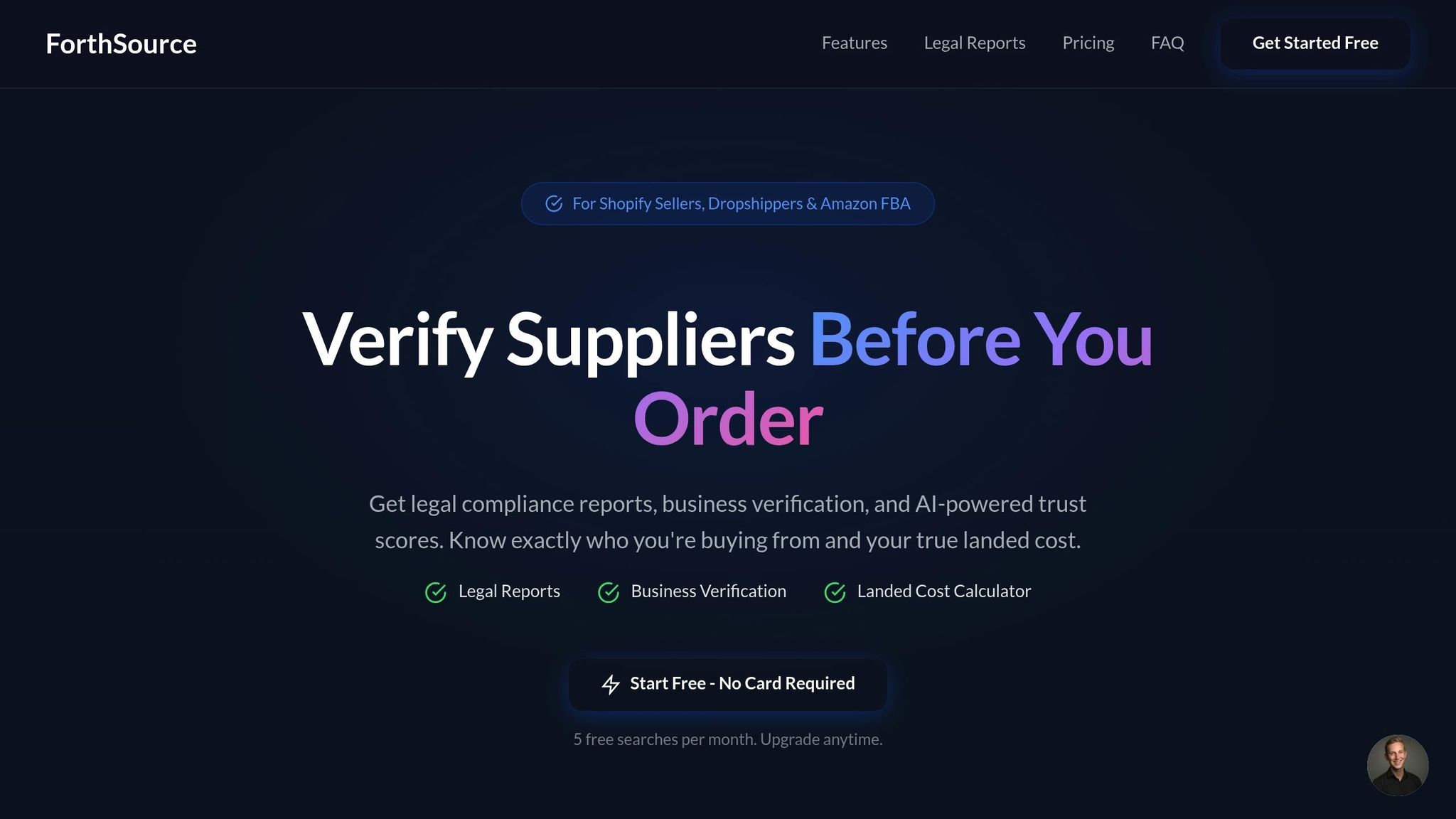
Manually checking suppliers across multiple databases can be a tedious and time-consuming process. ForthSource simplifies this by consolidating Alibaba data into a single interface. It uses a 0–100 Trust Score to quickly flag high-risk suppliers, saving you time and reducing uncertainty.
The platform eliminates sponsored listings and trading companies pretending to be factories, showing only suppliers ranked by verified data. You can compare multiple suppliers side-by-side with standardized metrics like response rates, transaction history, and compliance records. This streamlined approach complements traditional checks by offering fast, data-driven risk assessments.
How the Trust Score Works
The ForthSource Trust Score, ranging from 0 to 100, is built using data from Chinese business registries, trade history, and customer reviews. It validates business licenses by cross-referencing official sources such as the State Administration for Market Regulation and the National Enterprise Credit Information Publicity System. The score also factors in financial indicators, legal records, and any regulatory breaches.
The Free tier allows up to five supplier searches per month, providing basic checks like business license validity and Alibaba transaction volume. For deeper insights, Premium and Enterprise users gain access to advanced scoring, which includes data on tax compliance, enforcement actions, and other legal and financial details. To further ensure accuracy, you can compare the Trust Score with Alibaba's "Verified Supplier" or "Gold Supplier" badges for a more comprehensive verification.
Baidu Intelligence for Enterprise Users
Enterprise users ($99/month) get access to Baidu Intelligence reports, which pull data from domestic Chinese sources. These reports verify whether a factory exists at its registered address by cross-referencing Baidu Maps and local business directories. They also flag abnormal operation records and government-maintained blacklists that are often missing from Alibaba profiles.
For large orders, this feature is particularly useful. It validates the supplier’s Chinese legal name against official databases, ensuring the English profile matches the registered entity. Enterprise users receive 25 detailed Legal Reports per month, covering court case history, ownership changes, and tax compliance. This level of due diligence is critical for identifying risks, as discrepancies between reported and official information can signal underlying issues.
"China-specific due diligence goes further by accounting for: The Chinese corporate registration system and credit scoring; Government-maintained blacklists and abnormal operation records; Local certification regimes (such as CCC)." – SignalX
Using the Chinese legal name from ForthSource's Baidu Intelligence report, you can verify details on gsxt.gov.cn. Check that the registration date, legal representative, and business scope align with the supplier's claims. If Baidu Maps shows a factory signboard that doesn’t match the legal name, it could indicate a shell company or an unregistered operation. These checks integrate seamlessly into ForthSource’s verification system.
Real-Time Landed Cost Calculator
Premium users ($29/month) can access the Real-Time Landed Cost Calculator, which estimates shipping, duties, and taxes for over 100 countries using the SimplyDuty API. This tool uncovers hidden freight and customs fees, offering a clearer picture of total costs. By entering the product's HS code, weight, and destination, you can compare air, sea, and express shipping rates along with applicable tariffs.
The calculator even features HS code auto-classification for better accuracy, though it’s always smart to confirm the code with your customs broker before finalizing orders. Premium users are allowed 20 cost calculations per month, while Enterprise users get 100. For example, a supplier quoting $8.50 per unit FOB may seem cheaper than one at $9.20, but after factoring in shipping costs, the overall delivered cost could be higher. This transparency helps you negotiate more effectively with suppliers.
Third-Party Inspection Best Practices
Independent inspections are a crucial step in verifying that a supplier's operations align with what they claim. These checks go beyond initial supplier vetting, adding an extra layer of diligence. For example, a Q1 2026 audit revealed that 22% of Alibaba suppliers listed as "Factory" were actually trading companies posing as manufacturers. This kind of oversight helps catch issues early, safeguarding your brand's reputation.
Pre-Shipment and During-Production Inspections
A solid inspection process involves three key stages, ensuring quality at every critical point in production. Pre-Production Samples (PPS) help confirm that the raw materials match the specifications outlined in your order. Next, During-Production Inspections (DPI), conducted when about 30% of production is complete, allow inspectors to randomly check units for issues like stitching errors, color inconsistencies, or packaging flaws - problems that can still be corrected at this stage. Finally, Pre-Shipment Inspections (PSI) evaluate finished goods against Acceptable Quality Level (AQL) standards, ensuring the majority of items are ready to ship and meet your expectations.
To ensure thorough inspections, consider working with ISO/IEC 17020-certified firms like SGS, Bureau Veritas, or TÜV Rheinland. Before hiring, ask for a sample inspection report to assess the depth of their evaluations and the quality of their photographic documentation. It’s also wise to include contract terms specifying that critical defects - like electrical safety failures or missing FDA-required child-resistant closures - should result in a full batch rejection rather than a partial refund.
On-Site Factory Audits
On-site audits go beyond product inspections, offering a detailed look at a supplier's overall operations. These audits evaluate the factory's production capacity, quality control measures, and compliance systems. Inspectors typically tour key areas, including raw material storage, assembly lines, quality control checkpoints, and finished goods warehouses, to confirm the facility can handle your order volume. They also verify that the factory operates at its registered address and isn’t just a staged showroom. Costs for these audits generally range from $2,000 to $5,000, depending on the scope of the inspection and the firm conducting it.
As a preliminary step, request a live video walkthrough during working hours. To ensure authenticity, ask the supplier to show a wall clock or whiteboard with the current date visible. Additionally, verify the machinery being used - if precision processes like CNC milling are required, compare the equipment’s specifications to your production needs. Be cautious of suppliers operating at over 85% capacity or withholding material lot numbers, as these can be red flags for quality risks.
Conclusion
Supplier verification is about much more than just acquiring a badge. While statuses like Gold Supplier or Verified on Alibaba confirm basic legitimacy, they fall short of guaranteeing product quality or operational dependability. To ensure a thorough vetting process, it's essential to cross-check business licenses, review audit reports, and inspect product samples at key stages - before production, during production, and prior to shipment. These steps help you dig deeper than surface-level checks.
Prioritize suppliers with measurable performance metrics, such as a 97% on-time delivery rate or quick response times. Keep detailed records of all communications and leverage tools like Trade Assurance for payment security. While historical metrics provide valuable insights, platforms like ForthSource can simplify and speed up the verification process.
ForthSource aggregates Alibaba data and offers a 0–100 Trust Score, making it easier to assess supplier reliability. It also provides tools like a landed cost calculator and Baidu Intelligence for more informed decision-making. Instead of manually verifying each supplier’s credentials, you can compare reliability scores side-by-side. Premium members gain access to shipping and import duty estimates before contacting suppliers, while Enterprise users can validate factory legitimacy directly within China.
"The biggest ROI isn't lower prices - it's eliminating 3–4 months of back-and-forth verification for each new vendor."
– Li Wei, Head of Global Sourcing at Nestlé Supply Chain Asia
To safeguard your budget and brand reputation, combine Alibaba's resources with independent due diligence and specialized platforms. Start with trial orders, rely on Trade Assurance, and insist on third-party inspections for larger shipments. Investing time upfront in a rigorous verification process can save you months of dealing with quality issues or financial disputes later.
FAQs
How can I tell if a supplier on Alibaba is a factory or a trading company?
To figure out whether a supplier on Alibaba is a factory or a trading company, start by digging into their profile. Factories often emphasize their production capabilities, showcasing details like machinery, manufacturing processes, and their capacity to handle bulk orders. You'll also likely find certifications and quality control documents that back up their operations. On the other hand, trading companies act as middlemen, reselling products from various factories. Their profiles usually feature a wide range of products but lack detailed manufacturing information.
Another option is to reach out to the supplier directly. Ask about their production facilities, export experience, and certifications. Factories generally give more specific and detailed answers about their processes. For an even easier way to assess suppliers, platforms like ForthSource analyze verified data and assign trust scores, helping you spot legitimate factories faster.
What are the most trustworthy supplier badges on Alibaba?
When browsing Alibaba, two badges stand out for ensuring supplier reliability: Verified Supplier and Trade Assurance.
- Verified Supplier Badge: This badge indicates that the supplier has undergone a thorough third-party review. Their business credentials, like certifications and licenses, have been verified, giving you peace of mind about their legitimacy.
- Trade Assurance Badge: This badge adds an extra layer of security. It offers payment protection and guarantees on performance, ensuring that your transactions are safeguarded through Alibaba.
These badges are essential tools for identifying suppliers with a solid track record. They help minimize risks and make your sourcing process smoother and more secure. Always look for these indicators when assessing potential suppliers.
How can I maintain consistent product quality from a verified supplier?
To keep your product quality steady, you need a mix of thorough initial checks and regular monitoring. A verified supplier badge might confirm basics like licenses and certifications, but it doesn’t promise ongoing consistency. That’s why regular quality inspections - whether through third-party services or your own team - are a must to ensure products meet your standards.
Strong communication plays a huge role here. Set clear expectations from the start, ask for samples regularly, and tackle any quality issues as soon as they pop up. Tools like ForthSource can help you dig deeper into a supplier’s reliability by reviewing data such as transaction history and customer feedback. This can help you catch potential problems early. By fostering a transparent, long-term relationship and conducting regular performance reviews, you can count on your supplier to consistently deliver high-quality products.