Dealing with fake suppliers on Alibaba can lead to financial loss, legal risks, and damaged business reputation. Here’s how you can protect yourself:
- Use Alibaba’s filters: Prioritize suppliers with Verified Supplier, Trade Assurance, and Gold Supplier badges. However, these are not foolproof, so proceed with further checks.
- Watch for red flags: Unrealistic prices, off-platform payment requests, stolen images, vague descriptions, and evasive communication are common warning signs of scams.
- Verify credentials: Request business licenses, confirm factory addresses using tools like Baidu Maps, and check product certifications directly with issuing organizations.
- Leverage tools like ForthSource: Use automated platforms to quickly assess supplier reliability with Trust Scores and access deeper insights like financial stability and export compliance.
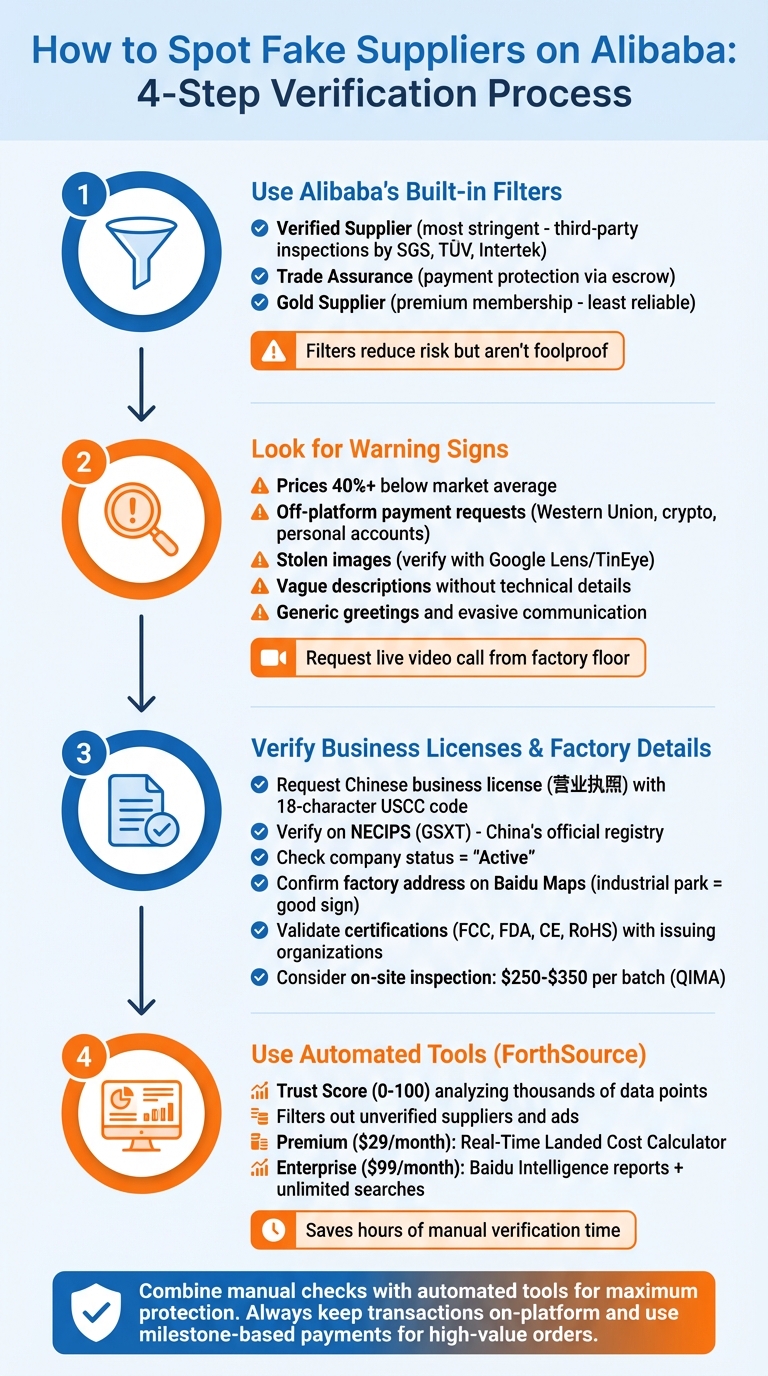
4-Step Process to Verify Alibaba Suppliers and Avoid Scams
Avoid Alibaba Scams: The Ultimate Guide to Finding Legit Suppliers
sbb-itb-633367f
Step 1: Use Alibaba's Built-in Filters
The first step in identifying fake suppliers on Alibaba is to take advantage of the platform's built-in filters. These tools help narrow down your options and identify suppliers that are more likely to be reliable. However, it's important to understand how each filter works and its limitations. Let’s break down how to use them effectively.
How to Apply Verified Supplier, Trade Assurance, and Gold Supplier Filters
Alibaba offers three key badges to filter suppliers: Verified Supplier, Trade Assurance, and Gold Supplier. Each serves a different purpose:
- Verified Supplier: This is the most stringent filter. Suppliers with this badge have passed on-site inspections conducted by independent third-party organizations like SGS, TÜV Rheinland, or Intertek. These audits review critical aspects like company profiles, production capacity, R&D processes, and quality control systems.
- Trade Assurance: This filter highlights suppliers who offer Alibaba’s escrow-like payment protection. Payments are held by Alibaba and only released once the agreed-upon terms are fulfilled. Keep in mind, this protection only applies to transactions completed entirely through the platform.
- Gold Supplier: This badge indicates that the supplier has paid for a premium membership on Alibaba. While it shows the supplier has invested in their presence, it doesn’t involve the same rigorous third-party audits as the Verified Supplier badge.
To apply these filters, use the checkboxes in Alibaba’s search sidebar. You can also search directly for "Verified" suppliers to focus on audited companies.
Why Alibaba's Filters Aren't Enough
While these filters are helpful, they’re not a foolproof solution. They can reduce risks, especially by eliminating Free Suppliers, who are often the riskiest. But even suppliers with badges can have hidden issues. For example:
- Subcontracting Risks: Even Verified Suppliers may outsource to unverified workshops, which can compromise quality.
- Middlemen Issues: Trading companies often pose as manufacturers, inflating prices for higher margins. Look at the "Business Type" field - if it says "Trading Company" or "Both", the supplier may not be a direct manufacturer.
Fraudsters have also become more sophisticated, using stolen images and videos from legitimate manufacturers to create fake listings. Additionally, Trade Assurance only protects payments made through Alibaba, meaning any off-platform transactions won’t be covered.
As Lansil Global points out:
Gold Supplier... Not a guarantee of reliability
And Sumsub adds:
Alibaba verification tools, which provide verified supplier badges... are not official licenses
While Alibaba’s filters are a great starting point, they need to be paired with thorough manual checks to minimize risks and avoid potential losses.
Step 2: Look for Warning Signs in Supplier Profiles
After using Alibaba's filters, it’s time to dig deeper into supplier profiles. Fraudulent suppliers often leave behind clues in their listings, pricing, and communication habits. Spotting these red flags early can save you from costly mistakes before you even reach out.
Be Wary of Unrealistic Prices and Off-Platform Payment Requests
If a supplier offers prices that are 40% below the market average, proceed with caution. Such extreme discounts are often bait-and-switch schemes. Scammers might send you a high-quality sample, only to deliver subpar goods in bulk orders later on. Genuine manufacturers base their prices on raw material costs, so significant deviations from the average often signal trouble.
Another major red flag is a supplier asking for payment outside Alibaba’s platform. If they push for direct bank transfers, Western Union, or cryptocurrency payments, walk away. These methods bypass Alibaba's Trade Assurance, leaving you without buyer protections. Once the money is sent off-platform, there’s no way to recover it if the supplier disappears or delivers defective products.
To establish a fair market price, compare quotes from at least 3–5 suppliers. Legitimate suppliers will also use corporate accounts that match their business licenses for payments. Avoid anyone asking for payments through personal accounts, even if they claim it’s for “rush orders” or “special fees”.
Look Out for Stolen Images and Vague Listings
Supplier listings can also reveal a lot. Scammers often use stolen product photos from legitimate manufacturers to make their profiles appear trustworthy. To verify whether images are authentic, use reverse image search tools like Google Lens or TinEye. If you find the same photo on multiple supplier profiles or unrelated websites, it’s a strong sign of a scam.
Pay attention to product descriptions as well. Legitimate manufacturers provide detailed information, including materials, dimensions, certifications, and production processes. Descriptions that rely on vague phrases like “high quality” or “best price” without specifics should raise concerns.
Ask technical questions about materials, machinery, or production timelines. Real factories can provide precise answers. Scammers, on the other hand, often give inconsistent or vague responses. If a supplier struggles to explain how their product is made or what equipment they use, they likely don’t own a factory at all.
Evaluate Communication and Responsiveness
How a supplier communicates can tell you a lot about their legitimacy. Be cautious of generic greetings like “Hello friend” or copy-pasted responses. These are often signs of trading companies or scammers running mass-messaging operations.
Slow replies or evasive answers to direct questions are another warning sign. If you ask about certifications, factory locations, or production capacity and the supplier either dodges the question or gives vague answers, it’s a red flag. Genuine suppliers are transparent and eager to build trust - they’ll provide clear and direct responses.
One of the most effective ways to verify a supplier is by requesting a live video call from their factory floor. Legitimate manufacturers will gladly show you their equipment, production lines, and inventory in real time. If a supplier refuses or comes up with excuses, it’s a strong indicator they don’t actually operate the facility shown in their profile. If red flags arise, the next step is to verify their business licenses and factory credentials.
Step 3: Verify Business Licenses and Factory Details
After spotting potential red flags in a supplier's profile, the next step is to confirm their legal credentials. This ensures the company is legitimate and operates as claimed. Skipping this step could lead to expensive mistakes with unreliable suppliers.
How to Request and Verify Business Licenses
Start by asking for a clear, color scan of the Chinese business license (营业执照) and the company's legal name in a copyable text format. Pay special attention to the 18-character Unified Social Credit Code (USCC), as it serves as the official company identifier.
To verify the license, use the National Enterprise Credit Information Publicity System (NECIPS), also called GSXT - China's official government registry. Always search using the USCC instead of the company name to avoid confusion with similarly named businesses. Ensure the company status is listed as "Active."
Review the Business Scope (经营范围) on the license to confirm it includes the products the supplier claims to manufacture. Also, make sure the legal name on the license matches the bank beneficiary name and any contracts. If the supplier later informs you of a bank detail change, verify this through a second communication channel, like a video call, to rule out fraud.
Confirm Factory Addresses Using Baidu Maps
Once legal credentials are verified, check the supplier's physical presence. Cross-reference the registered address with the location shown on their Alibaba profile. Use Baidu Maps - a reliable tool for detailed location data within China - to compare the address on the license with the map. Verify whether the address is in an industrial park (a good sign of a real factory) or in a residential or commercial area.
For extra assurance, review third-party audit photos in Alibaba's Verified Report. Compare these images with the street or satellite views on Baidu Maps to ensure consistency. If you're placing a large order, consider hiring a local inspection service to visit the site in person. Services like QIMA typically charge $250 to $350 per batch for on-site factory inspections.
Validate Product Certifications and Export Licenses
Checking product certifications and export licenses is another critical step in confirming a supplier's legitimacy. Verify certifications independently. For goods entering the U.S., confirm that electronics meet FCC standards, and ensure that food, medical devices, or cosmetics comply with FDA registration requirements.
Suppliers often display CE and RoHS certifications to show compliance with safety and environmental guidelines. To verify these, contact the issuing organization directly. For example, if the supplier provides an SGS or TÜV certificate, reach out to confirm its authenticity and current validity.
Additionally, check the "Trading Capabilities" section of the supplier's Alibaba profile to confirm their experience exporting to North America. This step adds another layer of confidence in their ability to meet your market's requirements.
Step 4: Use ForthSource for Faster Supplier Verification
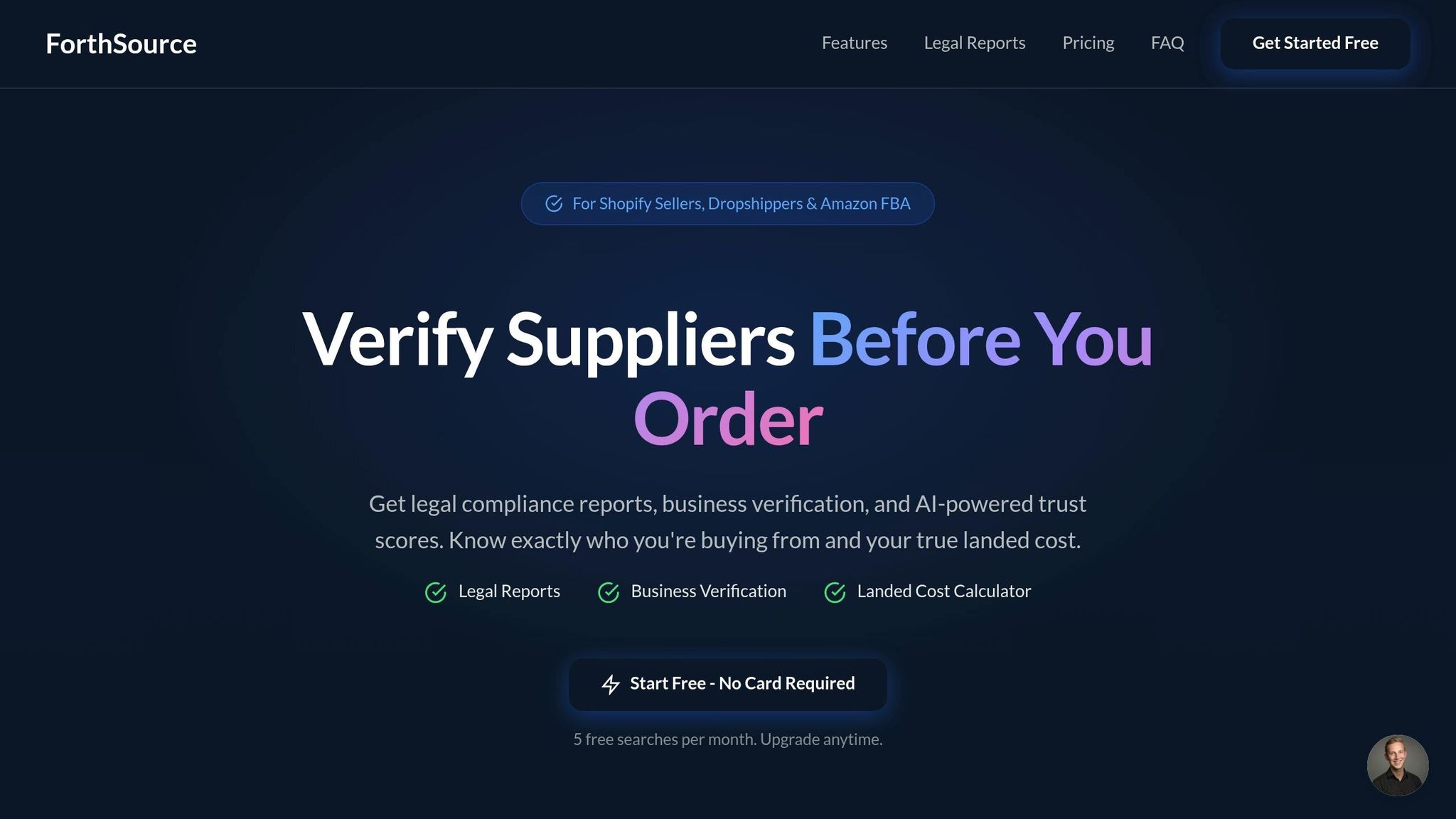
Manually verifying suppliers can take hours, eating into your valuable time. ForthSource simplifies this process by automating key checks, layering verified data directly onto Alibaba's marketplace. This gives you instant insights into a supplier's reliability, cutting down on the guesswork.
Understanding the ForthSource Trust Score
ForthSource evaluates thousands of data points from a supplier's Alibaba profile, such as verified business licenses, transaction history, response rates, and customer reviews. It distills all this information into a straightforward 0–100 Trust Score. Instead of manually reviewing business licenses and other documents, the platform automatically flags inconsistencies, saving you time and effort while helping you assess supplier legitimacy.
What sets the Trust Score apart is its inclusion of financial stability indicators - details not visible on standard Alibaba profiles. For example, a "Gold Supplier" badge may only indicate a paid membership, but the Trust Score digs deeper, revealing whether the supplier has been thoroughly vetted or poses potential risks.
Access Advanced Tools for Deeper Due Diligence
ForthSource doesn't stop at the Trust Score. It also offers advanced tools to enhance your supplier verification process:
- Premium Membership ($29/month): Gain access to the Real-Time Landed Cost Calculator, which estimates shipping rates and duties for the U.S. Using the SimplyDuty API to classify HS codes, this tool provides accurate duty estimates for over 100 countries. This way, you can calculate the total cost of your order before committing.
- Enterprise Membership ($99/month): Unlock Baidu Intelligence reports to confirm factory legitimacy using domestic Chinese data. These reports include details like court case history, regulatory violations, tax compliance, and export license checks. Such automated insights help you avoid costly errors, especially for high-volume orders.
Save Time with Cleaner Search Results
Alibaba's search results often include sponsored ads and unverified "Free Suppliers", which can pose a high scam risk. ForthSource eliminates these distractions by filtering out unverified suppliers and removing ads. Instead, it ranks suppliers based on verified data, making your search results cleaner and more reliable.
The platform also tracks your search history and enables side-by-side supplier comparisons. This feature makes it easier to identify red flags, such as inconsistent pricing or vague product descriptions, which could indicate fraudulent activity. With these tools, ForthSource streamlines supplier verification, helping you source safely and efficiently on Alibaba.
Conclusion
Combine Manual Checks with Automated Tools
Spotting fake suppliers on Alibaba requires a mix of manual diligence and automated tools. Start by using Alibaba's Verified and Trade Assurance filters, check business licenses through the NECIPS, confirm factory addresses on Baidu Maps, and request a live video call with the supplier.
While manual checks are essential, they can be labor-intensive and might miss subtle warning signs buried in supplier data. Automated tools like ForthSource simplify the process by analyzing vast amounts of data and delivering a clear Trust Score. This score helps you quickly gauge a supplier's credibility. By combining manual efforts with automated insights, you create a stronger defense against counterfeit suppliers, reinforcing the four-step process outlined earlier.
Next Steps for Safe Sourcing on Alibaba
Stick to the four-step process: filter, scrutinize, verify, and use automated tools. For high-value orders, use milestone-based payments and always arrange professional inspections. Avoid moving transactions off the Alibaba platform to ensure safety.
To get started, try ForthSource's free plan, which allows up to five searches per month and offers cleaner search results with Trust Scores. If you're sourcing regularly, the Premium plan at $29 per month includes a Real-Time Landed Cost Calculator to help you estimate import costs accurately. For businesses handling high-volume orders, the Enterprise plan at $99 per month provides unlimited searches and Baidu Intelligence reports, offering deeper insights into factory authenticity using domestic Chinese data - an added safeguard against advanced scams.
With Alibaba.com connecting over 48 million SMEs across more than 190 countries, combining thorough verification methods is key to finding reliable suppliers and avoiding costly mistakes.
FAQs
What is ForthSource?
ForthSource is a supplier intelligence platform tailored to enhance Alibaba sourcing. It offers a curated search experience, featuring a Trust Score that draws from verified data, customer reviews, and transaction history. This helps merchants identify reliable factories more efficiently.
Does it search other platforms?
No, ForthSource is dedicated solely to Alibaba suppliers. This focused approach allows it to offer more detailed insights, advanced filtering options, and precise reliability scores specifically designed for the Alibaba platform.
How does the "Trust Score" work?
The "Trust Score" simplifies the process of evaluating suppliers on Alibaba by analyzing thousands of data points. These include verified business licenses, transaction volumes, response rates, and customer reviews. All this information is distilled into a straightforward 0-100 score, offering a quick way to gauge a supplier's credibility.
Can I calculate shipping costs?
ForthSource provides premium members with access to a Real-Time Landed Cost Calculator. This handy tool estimates shipping costs - whether by air, sea, or express - to your location. It also calculates import duties and taxes, giving you a clear picture of the actual cost of a product before reaching out to a supplier.
What is "Baidu Intelligence"?
Baidu Intelligence is a specialized verification tool designed for enterprise users. It taps into domestic Chinese data sources through Baidu, providing a reliable way to confirm the legitimacy of factories operating within China. This tool is especially useful for businesses dealing with high-volume orders, offering an added layer of due diligence to ensure trust and transparency in their supply chain.
How much does it cost?
ForthSource provides three subscription options tailored to different needs:
- Free ($0/month): Includes 5 supplier searches, basic trust scores, and access to search history.
- Premium ($29/month): Offers 50 supplier searches, advanced trust scores, shipping calculators, import duty estimates, and the ability to email suppliers directly. Plus, there's a 7-day free trial to explore these features.
- Enterprise ($99/month): Designed for larger operations, this plan features unlimited supplier searches, Baidu intelligence reports, API access, and tools for team collaboration.
Why not just search Alibaba directly?
Searching on Alibaba can feel like navigating a maze. Sponsored listings often crowd the results, unverified suppliers pop up frequently, and scams are a real concern. Common warning signs include business details that can't be verified, pricing that seems too good to be true, and communication that feels inconsistent or shady. Without thorough checks, figuring out who's trustworthy can eat up a lot of time.
That's where tools like ForthSource come in handy. They streamline the process by cutting through the noise - filtering out unreliable listings, offering trust scores, and providing verified supplier data. This makes finding legitimate factories not only safer but also much faster.