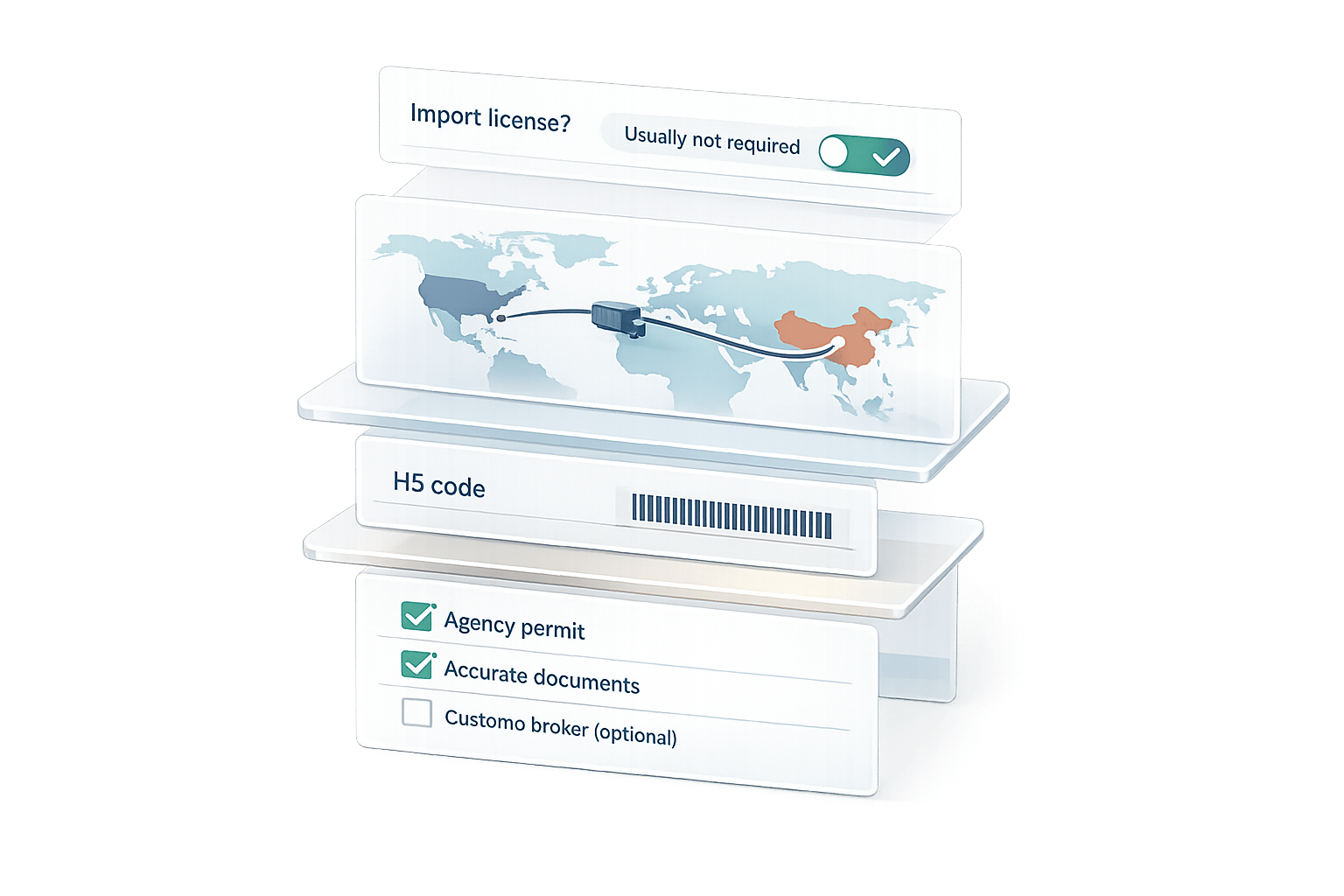
Importing from Alibaba can simplify sourcing, but clearing U.S. Customs requires accurate paperwork. Mistakes can lead to delays, fines, or even cargo seizures. To ensure smooth customs clearance, focus on these key documents:
- Commercial Invoice: Includes product details, values, HS codes, and origin. Ensure all information matches other documents.
- Packing List: Breaks down shipment contents, weights, and dimensions. Consistency with the invoice is crucial.
- Bill of Lading (BOL) or Air Waybill (AWB): Proof of shipment, containing shipper, consignee, and cargo details.
- Certificate of Origin (COO): Verifies where goods were made and is often needed for tariff reductions.
- HS Codes: Essential for calculating duties; incorrect codes can result in penalties or delays.
Double-check all details, use fair market values, and avoid vague descriptions. For complex imports, consider hiring a customs broker to prevent costly errors. Proper documentation minimizes risks and ensures timely clearance.
How To Handle Customs Documentation - Alibaba
sbb-itb-633367f
Step 1: Prepare the Commercial Invoice
The commercial invoice is the backbone of the customs clearance process. U.S. Customs and Border Protection (CBP) relies on this document to assess the value of your goods and calculate the duties you owe. It acts as both a sales receipt and a declaration for customs. Consistency across all your documents is critical to avoid unnecessary delays.
"The commercial invoice is one of the key documents that customs uses to determine the value of the goods and therefore the customs duties." - Roger Byrne, Machinery and Supply Chain Management Specialist, Alibaba.com
Getting this document right can save you from weeks of delays and costly storage fees. Precision and attention to detail across every section of the invoice are essential.
What to Include in a Commercial Invoice
A commercial invoice must follow a structured format and include specific details. Start with the basics: the full legal names, physical addresses, and contact details for both you (the importer) and your Alibaba supplier (the exporter). Be sure to include phone numbers, postal codes, and the countries for both parties. If someone else is receiving the shipment, make sure to list their complete name and address as the consignee.
Every invoice needs a unique, sequential invoice number and issue date. This helps customs track your shipment and ensures there’s no duplication. Double-check that these details match your supplier's records.
When it comes to describing your products, avoid being vague. Using only a SKU or generic term like "electronics" won’t cut it. Customs needs specifics. For example, instead of "toy", use a description like "plastic building brick toys for children aged 4-7". Include details like material, product name, purpose, and model or specifications.
"A SKU is not a product description." - Flexport
Financial details are crucial. List the unit price and total sale amount for each item in both U.S. dollars and your supplier's original currency. This reduces the risk of valuation disputes. Include your agreed Incoterms (e.g., FOB, CIF, or EXW) and payment terms (like Net-30) so customs knows who’s responsible for shipping costs and when payment is due.
Another key element is the 6-digit Harmonized System (HS) code for every product. This classification determines the duty rate for your goods. While Step 5 will dive deeper into finding the correct HS code, ensure it’s included on the invoice.
Finally, include physical shipment details: the quantity of units, unit of measure (e.g., pieces, boxes), net weight (goods only), and gross weight (goods plus packaging). Don’t forget to specify the country where the goods were manufactured - this is your country of origin.
To wrap it up, customs requires a signed certification statement verifying the accuracy of the information. Your supplier can include this, or you may need to sign it if you’re handling the paperwork.
Before moving forward, confirm that your packing list matches the details on your commercial invoice.
Common Errors to Avoid
One common mistake is declaring a $0 value, even for free samples or replacement items. Customs requires a declared value for everything entering the country. For items you didn’t pay for, use their fair market value instead.
"A declared value for every product imported is required, so a $0 value is not acceptable for Customs purposes." - Flexport
Also, avoid vague descriptions like "parts", "accessories", or "samples." Customs needs to know exactly what the product is, what it’s made of, and how it will be used. The more detailed your description, the smoother your customs clearance process.
Step 2: Create the Packing List
The packing list works alongside your commercial invoice but serves a different role. While the invoice focuses on financial details, the packing list provides customs officials, freight forwarders, and carriers with a detailed breakdown of your shipment's contents and packaging.
U.S. Customs and Border Protection mandates that all pre-alert documents, including the packing list, must be filed within 15 calendar days of your shipment's arrival. When prepared correctly, your goods usually clear customs within 24 hours. However, any inconsistencies can lead to inspections, which may delay clearance by a week or more.
Key Details to Include
Start by copying the names and addresses from your commercial invoice. This includes the full details for both you and your supplier, along with the commercial invoice reference number to link the two documents.
Your packing list should provide a thorough inventory of your shipment. Include the total number of packages or cartons, along with the exact quantity of each item. For weights, include three measurements: the net weight (goods only), the gross weight (goods plus packaging), and the tare weight (packaging alone). Also, provide precise dimensions for every package, carton, or pallet.
Clearly specify the type of packaging - whether pallets, boxes, crates, drums, or cartons - and include any identifying marks, serial numbers, or tracking labels. This helps customs match the paperwork with the physical cargo. Additionally, indicate your shipping method (ocean, air, or ground) and specify whether your shipment is classified as Less than Container Load (LCL) or Full Container Load (FCL).
To avoid delays, ensure these details align perfectly with your commercial invoice.
Ensuring Consistency with Other Documents
Double-check every detail against your commercial invoice to avoid inconsistencies. This includes unit quantities, product descriptions, and item counts.
"The information listed on the Commercial Invoice must match the corresponding fields on the Packing List (e.g., the quantity of units for each product should be the same on both the Commercial Invoice and the Packing List)." - Flexport
"I've seen cases where a packing list contained a different product count than the commercial invoice, and the cargo was held for verification - costing the importer both time and money"
Before submitting your documents, review them line by line. Product descriptions should be detailed and identical across both documents. For instance, if your invoice describes an item as "plastic building brick toys for children aged 4-7", your packing list should use the exact same wording. Consistency is key to smooth customs clearance.
Step 3: Obtain the Bill of Lading or Air Waybill
Once your commercial invoices and packing lists are ready, the next step is to secure the transport documents for your shipment. For ocean freight, this means obtaining a Bill of Lading (BOL), while for air freight, you'll need an Air Waybill (AWB). These documents serve as proof of transit and act as contractual agreements between you and the carrier.
These transport documents are essential for clearing customs. For shipments entering the U.S., ocean freight documents are typically processed five days before arrival, while air shipment documents are processed once the aircraft is in transit. Without the correct paperwork, customs clearance simply won’t happen.
Key Information to Include
Both the BOL and AWB should include the following details:
- Contact information for the shipper, consignee, and carrier
- A clear description of the cargo, including type, quantity, and destination
The product details must align perfectly with your commercial invoice and packing list. Avoid using only an SKU; instead, provide a full description, declared value, weights, and package counts to ensure consistency.
One major distinction between the two documents is that a Bill of Lading can act as a document of title, which proves legal ownership of the goods. If you're working with a negotiable BOL, you’ll need the original signed document to claim your shipment at the port. On the other hand, an Air Waybill is non-negotiable and functions as a receipt and tracking document only.
| Feature | Bill of Lading (BOL) | Air Waybill (AWB) |
|---|---|---|
| Mode of Transport | Ocean Freight | Air Freight |
| Document of Title | Yes (if negotiable) | No |
| Negotiability | Can be negotiable | Always non-negotiable |
| Release Process | Requires surrender of original (unless Express Release) | Goods released upon arrival to named consignee |
Once you’ve verified all the details, reach out to your supplier to request the necessary transport documents.
Requesting Transport Documents from Your Supplier
To avoid delays, it’s crucial to obtain accurate transport documents. Most suppliers on Alibaba generate or receive these documents from the carrier, so you’ll need to ask for them directly. As soon as your shipment is on its way, request digital copies immediately.
For ocean freight, suppliers often hold the Original Bill of Lading until you’ve completed payment. After payment, the physical document is usually sent to you via courier. If you’ve prepaid or want to speed up the process, ask for an Express Bill of Lading or a Telex Release. These options allow the carrier to release your goods without requiring physical documents, saving time.
You might also come across "House" versions (HBL or HAWB) issued by freight forwarders, as opposed to "Master" versions (MBL or MAWB) issued directly by carriers or airlines. Both are acceptable for customs clearance, but it’s important to confirm which one you’ll receive to avoid any confusion.
Lastly, double-check that all details - product names, quantities, and weights - are consistent across all documents. Any discrepancies could lead to customs delays.
Step 4: Secure the Certificate of Origin
Once your transport documents are in order, it's time to focus on another essential requirement: the Certificate of Origin (COO). This legal document confirms the country where your goods were either manufactured or underwent significant processing - it's not just about where they were shipped from. The COO plays a key role in determining whether your goods qualify for reduced or zero tariffs under trade agreements.
Customs authorities rely on the COO to verify the economic nationality of goods, enforce sanctions, and apply anti-dumping measures. Mistakes or inaccuracies in this document can lead to customs rejections, retroactive duty assessments, or even financial penalties. In fact, the World Customs Organization reported a 22% increase in COO-related detentions globally in 2023, often due to incomplete paperwork or documents issued by non-recognized entities.
"A Certificate of Origin is not a receipt - it's a sworn statement with legal standing. Its validity depends on the issuing authority, accurate completion, and reflection of the true supply chain." - Priya Mehta, Partner, Global Trade Compliance Group
When Is a Certificate of Origin Necessary?
A COO is required when claiming preferential duty rates under trade agreements. It's also needed for customs valuation, enforcing anti-dumping measures, or importing goods subject to quotas or embargoes. Even if your commercial invoice mentions the origin, many countries still demand a separate, formal COO for customs clearance. Any discrepancies between documents can result in delays and higher costs.
The type of COO you need depends on your trade situation:
- Preferential COO: Used to claim tariff concessions under specific trade agreements. It must include detailed production information, like regional value content percentages.
- Non-Preferential COO: Required for general customs purposes, such as valuation or quota monitoring. It typically contains basic details like product names, HS codes, and origin claims.
Here’s a quick comparison of the two:
| Feature | Non-Preferential COO | Preferential COO |
|---|---|---|
| Purpose | Customs valuation, anti-dumping, or quota monitoring | Grants reduced or zero tariffs under trade agreements |
| Issuing Body | Chamber of Commerce, notary, or self-declared | Strictly defined: Chambers of Commerce or customs authorities |
| Content Detail | Basic: names, HS code, origin claim | Detailed: production process, regional value content % |
| Authentication | Rarely requires stamping unless requested | Nearly always requires official stamp and signature |
How to Obtain a Certificate of Origin
Start by identifying the specific form required for your destination market. For example, some trade agreements necessitate particular forms like Form A for GSP or EUR.1 for EU-FTA. Provide your supplier with the exact regulatory requirements from your customs authority.
Determine whether your supplier can self-certify (as allowed under agreements like USMCA and CPTPP) or if the COO must be issued by an authorized body, such as a Chamber of Commerce. Request digital copies immediately and verify whether your country accepts electronic certificates or requires originals with wet-ink signatures. Double-check that the HS codes, product descriptions, and quantities align with your commercial invoice and packing list to avoid any issues.
For goods passing through a third country, ensure the COO includes "indirect consignment" and proof of non-manipulation. A real-world example highlights the risks of getting it wrong: In 2022, a German company exported €1.2 million worth of hydraulic valves to Vietnam under the EU–Vietnam Free Trade Agreement (EVFTA). Instead of the required Form D issued by an authorized EU body, they submitted a standard non-preferential COO. Vietnamese customs denied the 0% tariff, imposed a 5% duty, and added penalties and interest, resulting in a total liability of €217,450.
Step 5: Determine and Include HS Codes
After securing your Certificate of Origin, the next step is to focus on the Harmonized System (HS) code. This 6-digit universal code, created by the World Customs Organization (WCO), classifies products based on their type and use. Customs officials rely on these codes to set tariff rates, calculate duties and taxes, and track global trade. For imports into the U.S., this code expands to a 10-digit Harmonized Tariff System (HTS) code. Getting this code right is just as important as preparing accurate shipping documents.
Mistakes with HS codes can lead to serious problems. Using the wrong code could mean incorrect duty calculations, costly fines, shipping delays, or even confiscation by U.S. Customs and Border Protection (CBP). The financial consequences are steep: negligence penalties can be up to twice the lost duties or 20% of the product’s value, while gross negligence could lead to penalties as high as four times the lost duties or 40% of the declared value. Fraudulent declarations are even riskier, with penalties potentially reaching the full domestic value of the goods - essentially doubling the declared value.
How to Identify the Correct HS Code for Your Product
To find the right HS code, start with the World Customs Organization website, which provides the base 6-digit international classification. Next, check your country’s specific tariff schedule. For U.S. imports, refer to the Harmonized Tariff Schedule (HTS) maintained by the U.S. International Trade Commission. While your Alibaba supplier might offer an HS code, you should always verify it against local regulations.
Make sure to provide a detailed product description - just a SKU won’t cut it for customs purposes. If your product is particularly complicated, like pharmaceuticals or chemicals, consider hiring a licensed customs broker to ensure accuracy. Keep a record of how you verified the HS code. This shows "reasonable care", which can protect you from negligence penalties if issues arise later.
Consequences of Using Incorrect HS Codes
Getting the HS code wrong doesn’t just cost money - it also causes delays. Customs inspections can hold up your shipment for a week or more as it undergoes a physical review at a CBP-approved warehouse. Frequent errors increase your risk score in the Automated Targeting System (ATS), meaning future shipments are more likely to face scrutiny. In extreme cases, customs might seize your goods or even revoke your trading privileges. Keep in mind: as the importer, you are legally responsible for the accuracy of the HS code, even if you’ve hired a customs broker.
Additional Documents for Specific Products
When importing certain products into the U.S., the paperwork goes beyond the basics. Categories like electronics, food, and textiles come with their own set of regulatory requirements. Meeting these documentation standards is just as crucial as ensuring accuracy in commercial invoices and packing lists. Without the right product-specific paperwork, you risk delays - or worse - at customs.
Examples of Product-Specific Documentation
Electronics often have stringent requirements. For devices emitting electromagnetic signals - like smartphones, laptops, or wireless chargers - you’ll need an FCC Certificate to confirm compliance with U.S. standards for electromagnetic interference. If your products contain lithium batteries, you must also include a Material Safety Data Sheet (MSDS) and Dangerous Goods Forms to ensure safe and compliant transport. These documents should be requested from your Alibaba supplier well before shipment.
Food products come with their own unique challenges. Governed by the Food and Drug Administration (FDA), food imports require an Inspection Certificate to meet FDA standards. U.S. Customs and Border Protection (CBP) enforces these rules at the border. Given the high regulatory oversight, it’s wise to work with a licensed customs broker familiar with FDA requirements. Keep in mind that as the Importer of Record, you are legally responsible for the accuracy of all documentation. Errors or non-compliance can lead to hefty penalties.
Textiles demand a lot of detail in their documentation. A simple SKU number won’t cut it; you must provide exact fiber content, intended use, and manufacturing information. To qualify for reduced tariffs under trade agreements, a Preferential Certificate of Origin is often required. This document must meet "substantial transformation" criteria. Additionally, fiber content and care instructions must be included for CBP clearance. If your textile goods pass through a third country - say, from China to Singapore to the U.S. - your Certificate of Origin must clearly indicate "indirect consignment" and include proof of non-manipulation.
For all these product-specific documents, ensure that any certificates are signed by authorized signatories listed with the appropriate chamber of commerce. For example, a signature from a sales manager may not be valid under certain trade agreements. Don’t assume your freight forwarder knows all the requirements; always double-check the regulatory citations and confirm them through official U.S. trade authority portals before shipping.
Common Mistakes and How to Avoid Them
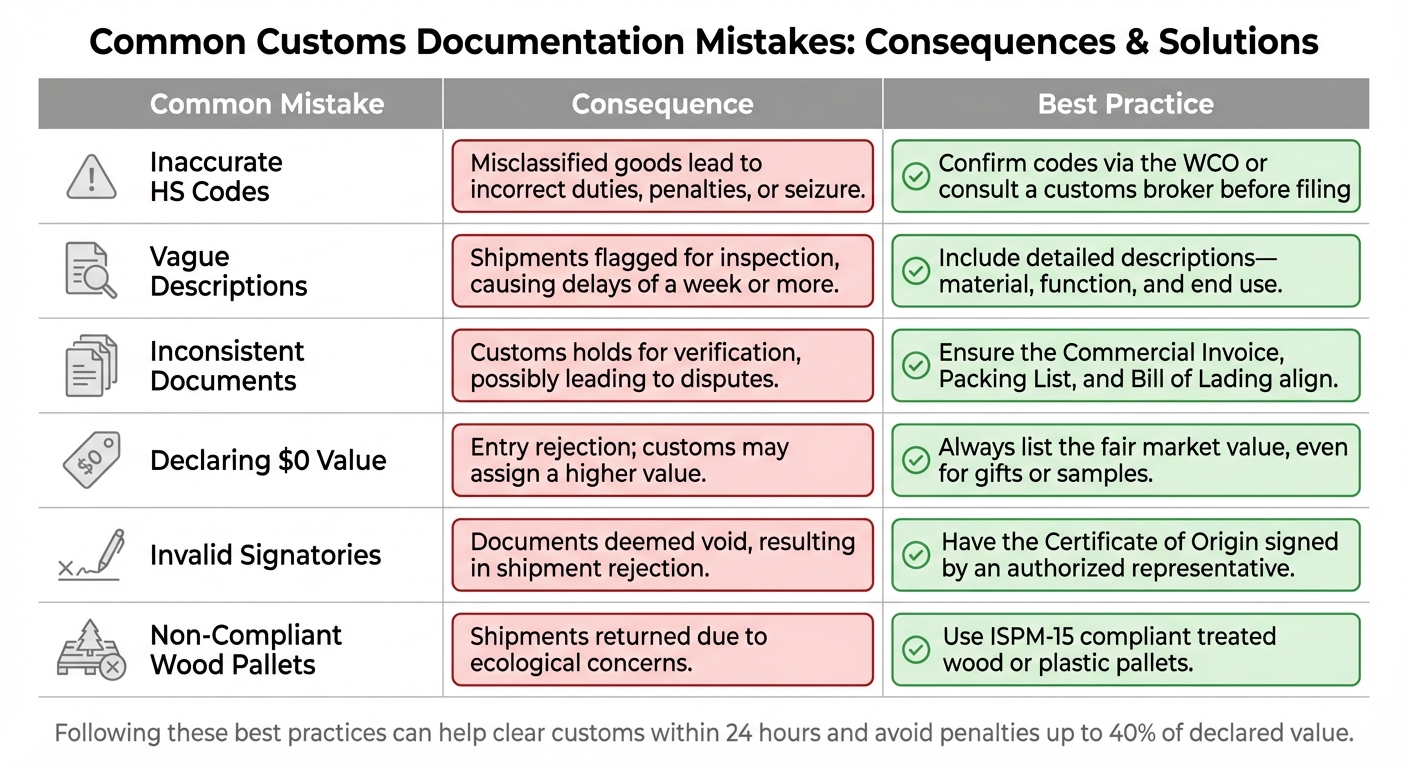
Common Customs Documentation Mistakes and Solutions for Alibaba Imports
Once you've prepared all the necessary documents, taking the time for a final review can save you from costly errors that might disrupt your shipment. Below, we’ll highlight frequent mistakes, their consequences, and how to steer clear of them.
Errors in documentation can lead to inspections, fines, and shipment delays. For example, using the wrong HS codes when classifying products can dramatically increase penalties. Civil penalties for negligence can reach up to double the lost duties or 20% of the declared value, while gross negligence can push that to four times the lost duties or 40% of the declared value. Additionally, vague product descriptions can prompt physical inspections, delaying shipments by a week or longer. While customs typically clears goods within 24 hours, any flagged concerns can extend this timeline significantly.
Consistency across your Commercial Invoice, Packing List, and Bill of Lading is critical. Even minor mismatches - like listing 500 units on one document but 485 units on another - can result in customs holds. Always declare the fair market value of all items, including samples and replacements, to comply with customs regulations. A 2022 case involving a German industrial equipment manufacturer illustrates how small errors can spiral: the company was fined €217,450 in back duties, interest, and penalties after submitting a standard Certificate of Origin instead of the specific "Form D" required under the EU-Vietnam Free Trade Agreement.
"A Certificate of Origin is not a receipt - it's a sworn statement with legal standing. Its validity hinges on who issues it, how it's completed, and whether it reflects the actual supply chain." - Priya Mehta, Partner, Global Trade Compliance Group
Comparison Table: Mistakes, Consequences, and Solutions
Here’s a quick breakdown of common errors, their impact, and how to avoid them:
| Common Mistake | Consequence | Best Practice |
|---|---|---|
| Inaccurate HS Codes | Misclassified goods lead to incorrect duties, penalties, or seizure. | Confirm codes via the WCO or consult a customs broker before filing. |
| Vague Descriptions | Shipments flagged for inspection, causing delays of a week or more. | Include detailed descriptions - material, function, and end use. |
| Inconsistent Documents | Customs holds for verification, possibly leading to disputes. | Ensure the Commercial Invoice, Packing List, and Bill of Lading align. |
| Declaring $0 Value | Entry rejection; customs may assign a higher value. | Always list the fair market value, even for gifts or samples. |
| Invalid Signatories | Documents deemed void, resulting in shipment rejection. | Have the Certificate of Origin signed by an authorized representative. |
| Non-Compliant Wood Pallets | Shipments returned due to ecological concerns. | Use ISPM-15 compliant treated wood or plastic pallets. |
Before your shipment leaves the supplier’s warehouse, double-check everything. Ensure product descriptions are consistent (e.g., material + name + function + end use). Confirm that quantities and weights match across all documents, and verify HS codes through official sources. For shipments involving complex items - like chemicals, medical devices, or those needing extra permits - it's worth hiring a licensed customs broker. The small upfront cost can save you from much larger penalties and delays.
Conclusion
Getting customs documentation right is the backbone of smooth Alibaba imports. By submitting accurate Commercial Invoices, Packing Lists, and Bills of Lading with the correct HS codes, you can typically have shipments clear customs within 24 hours of electronic processing. This not only cuts down on holding and storage fees but also helps you avoid steep penalties - these can be as high as four times the lost duties or 40% of the declared value.
Beyond the immediate financial benefits, proper documentation safeguards your long-term trading privileges.
"Mistakes in the customs process aren't cheap. The hidden costs of customs violations are steep: freight delays, cargo seizures, lost productivity as staff researches the infraction, and potential loss of trade privileges" - Alibaba.com
Every correctly processed shipment contributes to a positive compliance history with U.S. Customs and Border Protection. This reduces your risk profile and lowers the chances of future inspections. And it all starts with sourcing dependable suppliers.
Reliable suppliers are the foundation of accurate documentation. Trustworthy factories provide detailed Commercial Invoices and Packing Lists that are essential for customs clearance. They also supply Certificates of Origin and product specifications needed for proper classification and tariff determination. However, finding reliable suppliers on Alibaba’s vast platform can be a daunting task.
This is where ForthSource steps in. By using a verified Trust Score, ForthSource simplifies the process of identifying dependable Alibaba suppliers. This ensures you work with factories that deliver accurate documentation, streamlining customs clearance. By partnering with reliable suppliers and following these documentation best practices, you can ensure your shipments clear customs quickly and with minimal hassle.
FAQs
Who must prepare each customs document - me or the supplier?
When it comes to shipping, the supplier usually handles key documents like the commercial invoice and packing list. These papers outline the shipment's contents, value, and origin. On the other hand, as the importer, you’re in charge of submitting customs declarations and any necessary supporting paperwork. For example, in the U.S., this includes the Entry Summary (Form 7501). You can manage this process yourself or work with a customs broker to ensure everything is filed correctly with customs authorities.
How do I confirm the correct HS/HTS code for my product?
To find the correct HS/HTS code for your product, consult the Harmonized Tariff Schedule (HTS). This code is essential for customs authorities, such as CBP, to calculate duties and taxes based on your product's classification and description. Double-check that your product details are precise to prevent mistakes during customs clearance.
What happens if my invoice, packing list, and BOL/AWB don’t match?
Discrepancies between your invoice, packing list, and BOL/AWB can create serious headaches. These mismatches can result in delays, customs inspections, hefty fines, or, in extreme cases, the seizure of your goods. Whether it’s inconsistent values, incorrect descriptions, or mismatched quantities, such errors make customs clearance far more complicated. To steer clear of these problems, double-check that all your documents are accurate and aligned. Consistency is key.