Complete Guide to Alibaba AI Tools for Sourcing in 2026
Alibaba has invested heavily in AI sourcing tools most merchants never use. This guide covers every major tool, what it does, and how to build an AI-enhanced sourcing workflow for your Shopify store.
Hylke Reitsma is co-founder of Forthsuite and a supply chain specialist with 8+ years of hands-on experience at Shell, Verisure, and...
Why Alibaba's AI Tools Are a Game-Changer for Shopify Merchants
Alibaba has invested hundreds of millions of dollars in AI capabilities that most Shopify merchants have never tried. From smart product search to AI-powered supplier matching, these tools can cut sourcing research time from days to hours — if you know where to find them and how to use them effectively.
This guide covers every major Alibaba AI tool available in 2026, what each one actually does, and how to integrate them into a systematic sourcing workflow for your Shopify store.
Alibaba's Core AI Tools for Product Sourcing
1. AI-Powered Smart Search
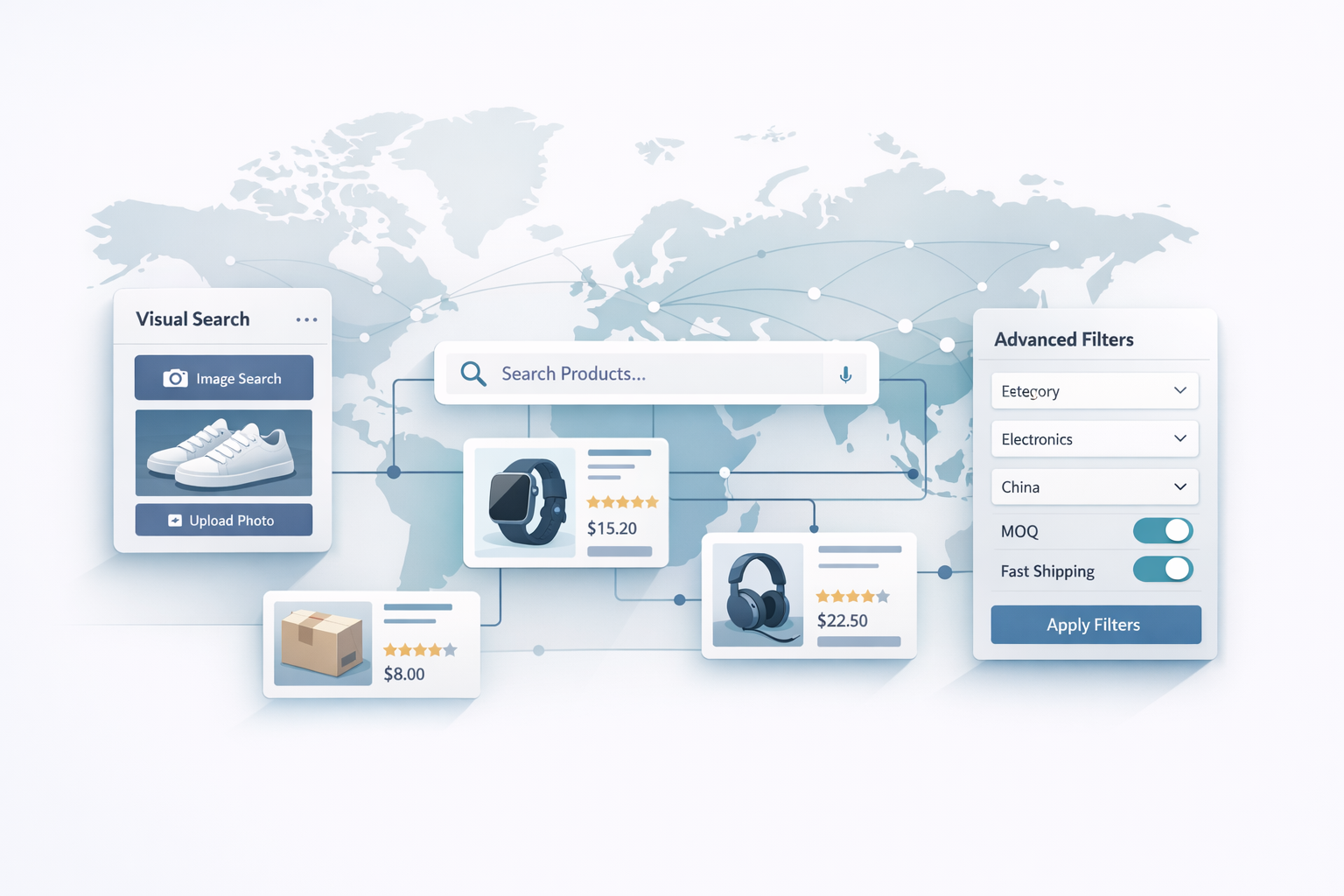
Alibaba's smart search (now powered by their large language model infrastructure) understands product intent rather than just keywords. Instead of searching "silicone phone case," you can describe "drop-tested phone case with card holder, matte finish, compatible with iPhone 16, MOQ under 200 units" and get suppliers that match your actual spec — not just the keywords.
To access smart search: look for the "AI Search" toggle in the main search bar, or use the RFQ (Request for Quotation) workflow which routes your detailed requirements through Alibaba's matching engine to relevant suppliers automatically.
2. Alibaba AI Supplier Matching
When you post an RFQ, Alibaba's AI ranks and routes your inquiry to suppliers based on transaction history, product category match, factory capabilities, and Trade Assurance status. The AI scoring is significantly more accurate than browsing manually — suppliers who receive matched RFQs tend to have better response rates and more relevant capabilities.
Key tip: write detailed RFQs (product specs, materials, packaging requirements, target price range, annual volume estimate) to trigger better AI matching. Vague RFQs get matched to vague suppliers.
3. Smart Pricing Intelligence
Alibaba's pricing intelligence tool shows you historical price trends for product categories, market-rate ranges for specific items, and seasonal pricing patterns. Access it through the "Market Prices" section on category pages or via individual product listing "price trend" indicators.
This tool is especially valuable for seasonal products: you can see how much prices fluctuate between low season and peak season, and time your bulk orders accordingly. For holiday products, ordering 4–6 months before peak demand typically saves 15–25% versus spot buying.
4. Image-Based Product Search
Upload a photo of any product and Alibaba's AI identifies similar products across its supplier database. This is particularly useful when you've found a product on a competitor's website or in a retail store and want to source it directly. The image search identifies matching products across thousands of suppliers in seconds, compared to hours of manual keyword searching.
Use this feature with product photos from: competitor dropshipping stores, retail shelf photos, Pinterest boards, and customer requests for specific items you don't currently stock.
5. AI-Powered Translation and Communication
Alibaba's built-in AI translation handles supplier communication in 16 languages with industry-specific vocabulary. You can use the AI message templates to generate professional inquiry messages that include all the specification details suppliers need, reducing the back-and-forth cycle from 5–7 messages to 2–3.
Alibaba's AI Tools for Supplier Vetting
Alibaba Verified Supplier AI Assessment
Alibaba's Verified Supplier program uses AI to analyze factory audit data and assign capability scores across six dimensions: quality management, production capacity, R&D capability, management system, social responsibility, and service reliability. These scores update dynamically based on buyer reviews and transaction data.
While these scores are useful, they only apply to suppliers who've paid for Alibaba's Verified Supplier program. For comprehensive supplier due diligence, you need to combine Alibaba's in-platform data with external registry verification.
Trade Assurance Score
Every Trade Assurance-covered supplier receives an AI-generated reliability score based on: dispute rates, on-time delivery performance, order volume history, and buyer satisfaction ratings. A Trade Assurance score above 4.8/5 with 50+ transactions is a reliable positive signal. However, brand new suppliers or those who don't use Trade Assurance won't have a score — which doesn't mean they're fake, but does mean you need additional verification through SAMR and direct reference checks.
How to Build an AI-Enhanced Sourcing Workflow
Phase 1: Product Discovery (AI Search + Image Search)
Start with Alibaba's smart search or image search to identify 10–15 candidate suppliers for your product. Use the AI filtering options to narrow by: Trade Assurance coverage, verified supplier status, minimum order quantity, and sample availability. Target your initial shortlist at 8–10 suppliers before starting active communication.
Phase 2: Qualification (AI Matching + Pricing Intelligence)
Post an RFQ with full product specifications to let Alibaba's AI matching route your inquiry to the most relevant suppliers. Simultaneously, use the pricing intelligence tool to establish your market-rate benchmark before receiving quotes. This prevents anchoring bias from the first quote you receive.
Phase 3: Verification (External Tools + Video Calls)
Alibaba's AI tools are powerful for discovery and initial filtering, but they don't replace external registry verification. Use Forthsource to verify shortlisted suppliers against China's SAMR registry, getting registration age, business scope, legal status, and an AI trust score based on non-Alibaba data sources. Then do a live video call with your top 3–4 candidates before placing sample orders.
For tips on spotting fake suppliers even with AI tools, see our guide on how to spot fake suppliers on Alibaba.
Phase 4: Negotiation (AI Price Benchmarks)
Use Alibaba's market price data to anchor your negotiation. Lead with a target price at 80–85% of the listed price, citing volume projections and your interest in a long-term supplier relationship. AI-generated price trend data shows seasonal fluctuations that you can use as leverage — quoting off-peak ordering as a benefit to the supplier's cash flow.
Advanced Alibaba AI Features Power Users Should Know
Alibaba's "Similar Factories" Recommendation Engine
When viewing a supplier profile, Alibaba's AI shows "Similar Manufacturers" based on product category, factory size, certification level, and geographic proximity. This feature is underused: instead of doing a new keyword search when you've found one suitable supplier, clicking "Similar Manufacturers" surfaces comparable suppliers who share key characteristics — often including competitors of your shortlisted supplier who may offer better pricing or terms.
AI-Powered Trend Analysis in the Sourcing Center
Alibaba's Sourcing Center has a trend analysis dashboard that shows category-level buying patterns across the platform. You can see which product categories have increasing quote activity, which are in decline, and which are seasonal. For Shopify merchants in product discovery mode, this data reveals market signals about what buyers are actively sourcing — which often correlates with consumer demand 3–6 months in the future, given typical import lead times.
Smart MOQ Negotiation Tool
A relatively new Alibaba feature allows you to request MOQ flexibility directly through the platform interface. The AI backend analyzes the supplier's historical MOQ acceptance rate and, for suppliers with a track record of flexibility, surfaces a "Request Lower MOQ" prompt with suggested counter-offer quantities. This doesn't work for all suppliers, but for suppliers with flexible pricing tiers, it streamlines what would otherwise require multiple negotiation messages.
Limitations of AI-Only Sourcing on Alibaba
Alibaba's AI is trained on platform data — which means it optimizes for signals visible within the Alibaba ecosystem. There are four significant blind spots:
- Off-platform fraud: Suppliers with clean Alibaba profiles who ask you to complete payment via wire transfer outside the platform. Alibaba's AI has no visibility into off-platform transactions.
- Certification fraud: AI can't verify whether a displayed certification is authentic. Always verify certifications directly with the issuing body (CE certification via the EU database, FCC via the FCC database, etc.).
- Quality consistency over time: A supplier's Alibaba score reflects historical performance, not current quality. Factories change ownership, management, and material suppliers. AI scores are lagging indicators.
- Price manipulation: Some suppliers inflate historical prices to make discounts appear larger. Alibaba's pricing AI can be gamed by suppliers who understand how the algorithm works.
The antidote to all four: use external verification tools alongside Alibaba's AI, order samples before every new bulk order, and verify certifications independently. Alibaba's AI is a powerful first filter — not a substitute for due diligence.
Connecting Alibaba AI Tools to Your Shopify Analytics
The most sophisticated Shopify merchants connect sourcing decisions to Shopify sales data rather than treating them as separate workflows. Specifically:
- Use Shopify's inventory reports to identify SKUs with sell-through rates above 80% — these are your reorder candidates, and their lead time data from Alibaba determines when to place the next order
- Track conversion rates by product to identify which sourced items have the best unit economics for reorder investment
- Use Alibaba's trend data alongside Shopify's search term analytics to validate that market-level supplier activity correlates with your store's consumer demand signals
For merchants sourcing at meaningful volume, connecting these data streams through a unified dashboard prevents both stockouts (ordering too late) and overstock (ordering too much of a product that's declining in demand). To understand how the full Alibaba ordering process works from RFQ to delivery, see our step-by-step guide.
Integration with Alibaba's Dropshipping Center
Alibaba's Dropshipping Center has AI-powered product trend analysis that shows which product categories are growing on Alibaba, and links directly to suppliers who support dropshipping (small quantities, no minimum orders). The trending product algorithm is updated weekly and segments by category, region, and price point.
The limitation: most truly high-margin products aren't available through dropshipping because legitimate manufacturers won't produce at sample quantities for every order. Use the Dropshipping Center for product research and supplier discovery, then convert to bulk ordering once you've validated a product with your Shopify audience.
Combining Alibaba AI with Your Shopify Store Data
The gap most Shopify merchants leave unaddressed: Alibaba's AI tools optimise for discovery within the Alibaba ecosystem, while your Shopify analytics optimise for understanding your customers. Bridging these two data sets is where sourcing decisions become genuinely data-driven. Use Shopify's best-seller and sell-through data to decide which products deserve a bulk order commitment, then use Alibaba's pricing intelligence to time that order to the most favourable pricing window. Reverse the process for new product launches: use Alibaba's trend data as a leading indicator of categories gaining supplier activity (typically a 3–6 month precursor to consumer demand), then validate with a small Shopify test before committing to inventory. This loop — sourcing insight feeding Shopify testing, Shopify data validating sourcing commitment — compounds over time into a sustainable product selection advantage.
What Alibaba's AI Tools Can't Do (And What You Need Instead)
Alibaba's AI tools are designed to surface Alibaba-ecosystem data: transaction history, in-platform reviews, and verified information that suppliers have submitted to Alibaba. They cannot:
- Verify business registration status against China's official SAMR registry
- Identify suppliers who have legitimate Alibaba profiles but fraudulent off-platform operations
- Check export compliance records or customs data independently
- Provide objective supplier assessments (Alibaba has a financial incentive to keep suppliers on the platform)
For comprehensive supplier due diligence that combines Alibaba platform data with external registry verification, use Forthsource alongside Alibaba's AI tools. For tips on identifying fake suppliers even when they have polished Alibaba profiles, see our guide on how to spot fake suppliers on Alibaba.
About the Author

Hylke Reitsma is co-founder of Forthsuite and a supply chain specialist with 8+ years of hands-on experience at Shell, Verisure, and Stryker. He holds an MSc in Supply Chain Management from the University of Groningen and writes practical guides to help e-commerce teams run leaner, faster supply chains.
LinkedIn