Scams in sustainable sourcing are on the rise, and businesses need to stay vigilant. From false eco claims to forged certifications, these fraudulent practices can damage reputations, lead to financial losses, and invite regulatory penalties. Here’s what you need to know to protect your supply chain:
- False Claims: Misleading labels like "organic" or "recycled" are common. Studies show 57% of businesses make questionable environmental claims.
- Fake Certifications: Fraudulent documents like ISO or FSC certifications create false trust. Over 340 companies in the forest products industry have been flagged despite holding certifications.
- Phantom Suppliers: Scammers posing as suppliers disappear after receiving payments via untraceable methods.
- Bait-and-Switch: Suppliers substitute cheaper, non-compliant materials during bulk production, risking product recalls and legal action.
How to Protect Your Business:
- Verify Claims: Demand solid evidence for eco-labels and certifications. Use tools like the FTC Green Guides and official certification databases.
- Fraud Prevention Controls: Confirm payment details match licensed businesses. Use traceable payment methods and third-party inspections.
- Supplier Vetting Tools: Platforms like ForthSource provide real-time trust scores and detailed supplier intelligence reports.
- Legal and Documentation Checks: Review business licenses, tax IDs, and customs records. Draft contracts that include penalties for misrepresentation.
By implementing thorough verification processes, using data-driven tools, and maintaining strong contracts, you can safeguard your supply chain from fraud while meeting consumer expectations for ethical practices.
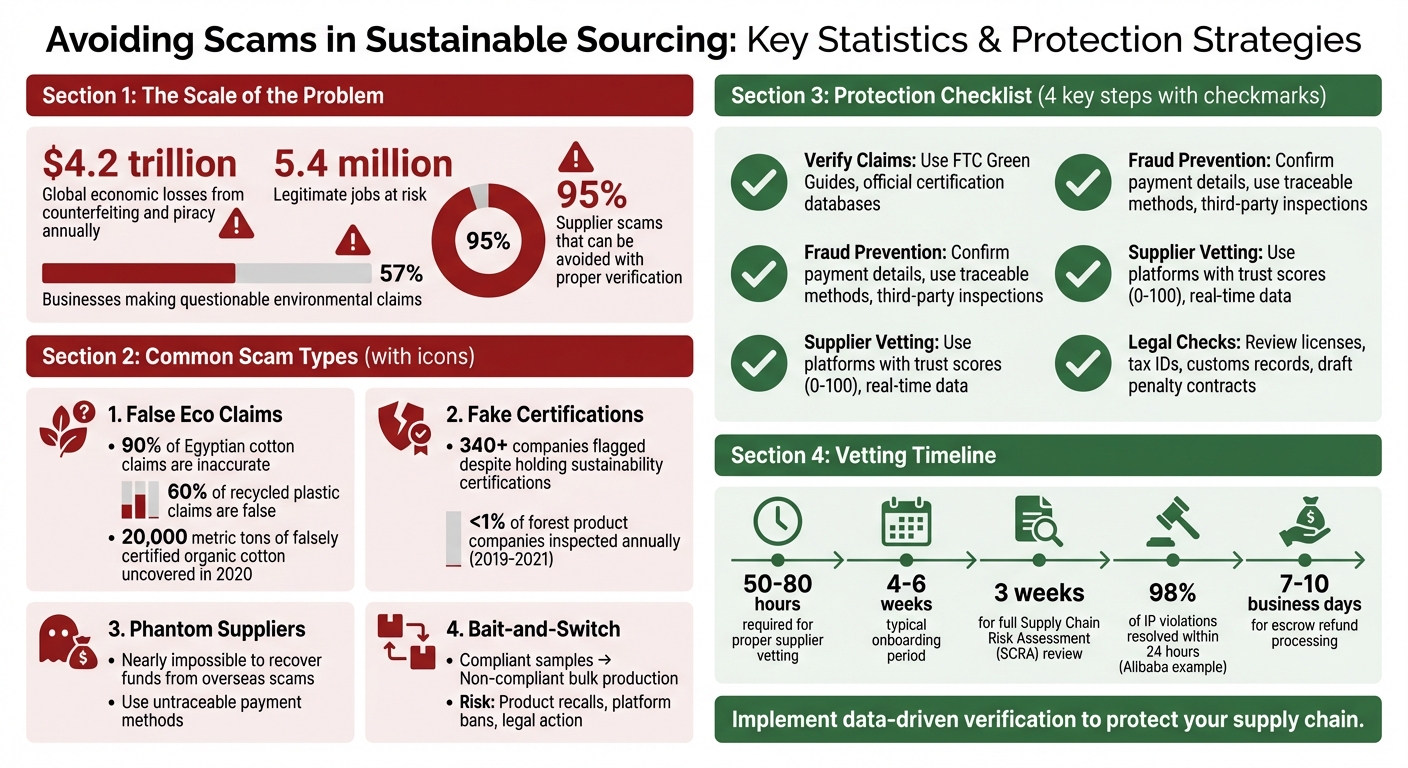
Common Sustainable Sourcing Scams: Types, Statistics and Prevention Methods
Common Scams in Sustainable Sourcing
Understanding and identifying scams in sustainable sourcing is crucial to safeguarding your supply chain from financial and reputational harm.
False Eco Claims and Greenwashing
Some suppliers falsely label products as "organic", "recycled", or "FSC-certified" to justify higher prices, even when those claims are untrue. For instance, studies have shown that up to 90% of Egyptian cotton claims and 60% of recycled plastic claims are inaccurate. In 2020, the Global Organic Textile Standard (GOTS) uncovered that 20,000 metric tons of Indian cotton - nearly one-sixth of the country's total organic cotton production - were falsely certified as organic.
"I would argue that the vast majority of cotton that is presented to consumers as organic is not, in fact, organic cotton." – Crispin Argento, Managing Director, The Sourcery
These false claims can lead to severe consequences. In 2016, U.S. retailer Target cut ties with Welspun India after discovering that 750,000 sheets and pillowcases labeled as 100% Egyptian cotton were actually made with non-compliant materials. Beyond misleading labels, some suppliers manipulate certification and auditing processes to deceive buyers.
Fake Certifications and Fabricated Audit Reports
Even certifications that seem legitimate can be fraudulent. Scammers often exploit outdated, paper-based systems to forge documents like ISO, GOTS, and FSC certifications. One investigation revealed that at least 340 companies in the forest products industry were flagged for harmful practices despite holding certifications for sustainability. Between 2019 and 2021, less than 1% of companies trading forest products in EU member states were inspected annually, creating significant opportunities for fraud. Additionally, fabricated audit reports often provide a false sense of security, showcasing compliance with labor, environmental, and material standards that doesn’t actually exist.
While fake certifications breed false trust, intermediaries posing as manufacturers add another layer of complexity.
Trading Companies Disguised as Manufacturers
Intermediaries often present themselves as factories to secure orders and pocket higher profits. This practice obscures the true origin of materials and makes it nearly impossible to verify labor conditions or environmental impact.
"The fashion supply chain is super fragmented and very dense... It's hundreds of hands that an item passes through before it comes into the consumer's hands." – Kathleen Rademan, Director of Innovation Platform, Fashion for Good
A key warning sign is when a supposed "manufacturer" offers an unusually broad range of unrelated products. This often indicates you're dealing with a trading company rather than a genuine factory.
Phantom or Shell Suppliers
Phantom suppliers create convincing storefronts for products that don’t exist, demanding untraceable payments via methods like Western Union or personal bank accounts before disappearing. Recovering funds from such scams, especially overseas, is nearly impossible.
"The sad truth is, if a buyer gets tricked, it's almost impossible to get back any lost money." – WOZO Sourcing
Red flags include sudden changes in payment recipient details, refusal to provide physical samples, and requests for payments outside secure escrow systems. Some fraudsters even exploit platform verification systems by renting accounts from legitimate suppliers, making their operations appear credible when they are actually shell companies.
Bait-and-Switch Materials and Production
A common scam involves providing compliant samples but substituting cheaper, non-sustainable materials during bulk production. Known as "Chabuduo" (meaning "close enough"), this tactic might involve replacing certified organic cotton with conventional cotton or swapping recycled materials for virgin plastic.
The fallout from such practices can be severe. Non-compliant materials may lead to product recalls, bans from platforms like Amazon, and legal action under regulations such as the U.S. Uyghur Forced Labor Prevention Act. Since its enforcement began in June 2022, companies have faced shipment impoundments unless they can provide forensic proof of material origins. Without third-party factory inspections, businesses risk jeopardizing their entire supply chain.
Data-Driven Solutions for Avoiding Scams
Did you know that about 95% of supplier scams can be avoided with proper preparation and verification? Thanks to modern data tools, fraudulent suppliers can often be spotted before any money changes hands. Let’s explore some practical, data-driven steps you can take to safeguard your supply chain.
Verifying Sustainability Claims With Evidence
When it comes to eco-labels, claims need to be backed by solid, scientific proof. For example, the FTC Green Guides state that a product can only be labeled "recyclable" without qualification if at least 60% of consumers in the area have access to recycling facilities for that product. Similarly, claims of being "biodegradable" must show that the product will completely break down within a year of disposal.
Organizations like the Rainforest Alliance use Supply Chain Risk Assessment (SCRA) systems to evaluate risks at specific sites. These systems consider factors like location, activities, and compliance history, assigning risk levels from A to E. Lower-risk sites might only need a desk review, while higher-risk ones require on-site audits by third-party certification bodies. A full SCRA review typically takes about three weeks. This process helps combat deceptive eco claims and greenwashing.
To further validate sustainability claims, request chain-of-custody documentation and check certification numbers against official databases. For carbon offset claims, demand clear evidence that reductions are accurately measured and that offsets haven’t been sold multiple times.
Setting Up Procurement and Fraud Prevention Controls
Strong internal controls are key to protecting your supply chain from fraud. Always confirm that payment details match the licensed business name and stick to traceable payment methods. Be cautious of last-minute changes or requests for untraceable transfers. In China, legitimate suppliers often bank with one of four major institutions: ICBC, China Construction Bank, Agricultural Bank of China, or the Bank of China.
Before placing large orders, request physical samples and use third-party inspection services to ensure that the final goods match the approved samples. Be wary of suppliers who refuse to send samples or demand full payment upfront - these are major red flags.
Additionally, watch out for supply chains that seem overly complex or have more tiers than expected, as these can increase the risk of fraud. Suppliers offering an unusually broad range of unrelated products may also be a sign of a trading company rather than a manufacturer.
Using Supplier Intelligence Tools Like ForthSource
Platforms like ForthSource simplify the supplier vetting process by consolidating data and offering a Trust Score based on verified information, transaction history, and other credibility markers. This score, ranging from 0 to 100, allows sourcing managers to quickly assess supplier reliability without sifting through endless unverified profiles.
ForthSource’s Premium tier ($29/month) includes a Real-Time Landed Cost Calculator, which estimates shipping costs (air, sea, or express) and calculates import duties and taxes - giving you a clear picture of the true cost before you even contact a supplier. The Enterprise tier ($99/month) goes a step further with Baidu Intelligence Reports, which use domestic Chinese data to verify factory legitimacy.
These tools also help differentiate manufacturers from middlemen by analyzing product catalogs and business scopes. They track risk indicators like legal actions, court announcements, equity freezes, and environmental penalties.
Using External Data and Legal Checks
To confirm a supplier’s legitimacy, verify their 18-digit unified social credit code, financial health, and customs registration through China's National Enterprise Credit Information Publicity System. While this system is primarily in Chinese, third-party services can provide translated reports.
Third-party verification providers typically offer two types of reports. A basic report (around $78) includes registration details, legal representatives, and business status. A more comprehensive report (around $128) adds information on legal actions, environmental penalties, intellectual property data, and customs records. These reports can identify untrustworthy entities, legal disputes, and unpaid debts.
Other checks include comparing registered capital to paid-in capital and reviewing tax ratings for financial stability. Verify customs registration codes and ensure declaration periods are valid for international trade. Additionally, the number of insured employees can help you distinguish between a factory (with many employees) and a trading company (with fewer employees).
For labor and human rights concerns, consult resources like the U.S. Department of State's Trafficking in Persons Report and the U.S. Department of Labor's List of Goods Produced by Child Labor or Forced Labor. These tools can help identify high-risk commodities and regions. Also, cross-check intellectual property records to ensure the supplier hasn’t registered your brand without permission or is selling counterfeit goods.
sbb-itb-633367f
Building a Long-Term Sustainable Sourcing Process
To safeguard your supply chain from scams, you need systems that provide continuous oversight. Supplier vetting usually requires 50–80 hours over four to six weeks. Workflows designed to catch issues early can keep your supply chain strong and compliant.
Establishing a reliable onboarding process is the foundation for long-term supplier success.
Creating a Sustainable Supplier Onboarding Workflow
Start by clearly defining your product specifications - this includes materials, tolerances, necessary certifications (like ISO 14001 for environmental standards), minimum order quantities, and lead times - before reaching out to potential suppliers. This upfront clarity avoids miscommunication and compliance issues.
Implement a multi-step screening process to verify essential details like licenses, tax IDs, and facility locations. Use official databases such as China's National Enterprise Credit Information Publicity System. When reviewing certifications like ISO 9001, BSCI, or SA8000, don’t just accept PDF copies. Always verify expiration dates and confirm the certifications are relevant to your product category.
The most effective onboarding workflows use a phased "go/no-go" system. Suppliers must meet key milestones, such as passing sample evaluations and completing a 10–30% trial production run, to identify quality issues before scaling up. As Eliza from Sourcify notes:
"Supplier vetting is not a one-and-done activity. It's a continuous process of setting the right standards, monitoring performance, evolving with your business and staying ahead of supply-chain risk."
This structured approach reduces the chances of scams and ensures compliance with sustainable practices.
| Onboarding Phase | Key Actions | Risk Mitigated |
|---|---|---|
| Discovery | Define specs, research regulations (FDA, CE, REACH) | Compliance issues, misaligned expectations |
| Verification | Validate business licenses, tax IDs, geolocation | Fake companies, "phantom" suppliers |
| Evaluation | Audit certifications, conduct sample testing | Poor quality, unethical labor practices |
| Contracting | Draft bilingual agreements with IP and penalty clauses | IP theft, limited legal protection |
| Trial | Conduct a small production run with independent QC | Mass production defects, scaling challenges |
Once suppliers are onboarded, ongoing monitoring is essential to maintain performance.
Monitoring Supplier Performance Over Time
Use a scorecard to track key metrics like product quality, cost stability, on-time delivery, responsiveness, and innovation. Regular reviews - monthly or quarterly - can help you spot trends such as rising defect rates or shipment delays before they escalate.
Independent third-party audits provide an unbiased assessment of factory conditions. While scheduled visits may present a polished view, unannounced inspections often reveal the true state of daily operations and labor practices. Professional inspection services can also confirm that mass production matches approved samples.
Be alert to events that warrant immediate reviews, such as changes in bank details, company leadership, business names, or unexpected price hikes. These changes can signal fraud or financial instability. Additionally, monitor the length of your supply chain - excessively long chains or unrealistic profit margins are red flags for labor exploitation or fraud. For example, in 2023, Alibaba's anti-counterfeiting alliance resolved 98% of intellectual property violations within 24 hours, protecting over 730,000 brands. This highlights the importance of proactive monitoring.
Secure your sourcing process further with strong contracts and thorough documentation.
Contractual and Documentation Safeguards
Contracts should include specific sustainability criteria, such as requirements for supply chain transparency, tax compliance, and restrictions on subcontracting without prior approval. Include audit rights to review both the supplier's compliance and their subcontractors’ practices.
Outline penalties for misrepresentation, whether it involves fake certifications, material substitutions, or labor violations. Draft bilingual contracts that clearly define quality standards, IP protections (like NDAs and mold ownership), and penalty terms for delays or defects. Always verify that bank account details match registered business information, and avoid last-minute changes to payment recipients.
Documentation should include verified business credentials, such as directorship records, VAT registration, and financial statements. Use standardized sustainability questionnaires to assess greenhouse gas emissions and labor standards. A well-documented supply chain builds resilience, attracts investors, and adds long-term value.
Conclusion: Protecting Your Supply Chain With Data and Tools
Fraud in sustainable sourcing costs businesses billions of dollars each year. Counterfeiting and piracy alone are expected to result in $4.2 trillion in global economic losses, while also jeopardizing around 5.4 million legitimate jobs. Taking a structured, data-driven approach can shield your brand from financial, regulatory, and reputational damage.
Start by implementing multi-layered supplier compliance checks at every step. For example, verify business licenses through official government databases like China's State Administration for Market Regulation (SAMR). Conduct third-party audits using trusted organizations like SGS, Bureau Veritas, or TÜV Rheinland to confirm factory certifications and capabilities. These thorough checks create a solid foundation for using advanced tools to enhance your supply chain.
Platforms like ForthSource simplify supplier verification by pulling together real-time trust signals and third-party validations. Instead of spending 50–80 hours manually researching suppliers, you can focus on key metrics - such as reorder rates, on-time delivery performance, and factory locations in industrial hubs like Guangdong for electronics. Real-time data also flags potential risks before you commit. For instance, Alibaba's anti-counterfeiting alliance resolved 98% of intellectual property infringement cases within 24 hours in 2023, protecting 730,000 brands. This demonstrates the effectiveness of proactive monitoring when paired with reliable data.
Securing your payments is just as critical. Escrow services like Trade Assurance ensure funds are only released once product specifications and sustainability requirements are met. Validated disputes are typically resolved with refunds processed within 7–10 business days. To maintain legal protection, finalize all product details, certifications, and dispute terms within the platform's system.
Building a resilient, scam-free supply chain requires ongoing effort. Set high standards, continuously monitor supplier performance, and use smart tools to safeguard your brand while staying true to your sustainability goals. By doing so, you can protect your business and uphold the promises you've made to your customers.
FAQs
How can I ensure eco-labels and certifications are legitimate?
When evaluating eco-labels and certifications, it's important to ensure they come from a trusted third-party certifier. Visit the certifier's official website or database to confirm the product is genuinely certified. Also, make sure the certification complies with the FTC Green Guides, which emphasize principles like clarity, accuracy, and transparency. This approach helps you steer clear of misleading claims and ensures the product adheres to credible sustainability standards.
What are the warning signs that a supplier might be a scam?
When evaluating suppliers, it’s important to stay alert for warning signs that could indicate potential scams. Look out for things like unverified business registrations or vague physical addresses, reluctance to share factory photos or provide product samples, and requests for unusually large upfront payments. Be especially wary of deals that seem too good to be true, suppliers using generic email domains, or communication that feels inconsistent or evasive.
To minimize risks, consider using tools like ForthSource. Platforms like this analyze key factors such as supplier credibility, pricing, and legal records. This data-driven approach can help you make smarter, safer decisions when sourcing suppliers.
How can tools like ForthSource help identify and avoid scams in sustainable sourcing?
Platforms like ForthSource leverage cutting-edge tools to make the sourcing process more secure and dependable. By integrating real-time pricing data, supplier credibility indicators, WeChat activity, and legal documentation into a unique scoring system, ForthSource enables users to evaluate supplier trustworthiness quickly and effectively.
On top of that, its AI-driven risk dashboards and automated data analysis highlight potential warning signs, helping businesses make smarter choices and avoid scams. This empowers brands to source with confidence, supported by trustworthy insights and clear quality metrics.