Alibaba Cloud transforms manufacturing by connecting equipment, analyzing data with AI, and enabling virtual testing. Here's how it addresses key industry challenges:
- Disconnected Systems: Many factories struggle with isolated machines and siloed data. Alibaba Cloud integrates IoT and edge computing, ensuring real-time communication and centralized data access.
- Scaling Costs: Expanding operations often requires costly upgrades. Cloud-based solutions and digital twins allow virtual testing and reduce physical resource use.
- Maintenance Issues: Predictive AI tools anticipate equipment failures, cutting downtime and repair costs.
Results: Companies like Trina Solar and GCL Power improved production quality and efficiency by leveraging Alibaba Cloud's tools. Automotive and industrial giants, including Ford and Schneider Electric, also use these solutions for better supply chain and production management. This includes utilizing the best supplier sourcing tools to streamline procurement.
Alibaba Cloud is reshaping manufacturing by solving long-standing inefficiencies, enhancing productivity, and enabling smarter decision-making.
Iotdb Practice In Ali Cloud Intelligent Manufacturing Business
sbb-itb-633367f
Common Problems in Traditional Manufacturing
Traditional manufacturing systems often face challenges like isolated processes and reactive problem-solving, which can weaken their ability to compete effectively.
Disconnected Systems and Missing Real-Time Data
Many traditional factories operate with fragmented systems and siloed data spread across various business units. Machines don’t communicate with one another, and critical information remains isolated. This lack of integration creates a barrier to sharing data across the supply chain or the broader industry.
When issues arise, finding the root cause is slow and inconsistent because there’s no unified system to track and analyze patterns across the production line. This disconnection also drives the bullwhip effect, where demand signals become distorted along the supply chain. Small changes in customer orders can snowball into overproduction or shortages, as each link in the chain reacts based on incomplete or inaccurate information.
"The essence of the industrial Internet is that advanced information technologies are applied and practiced in the manufacturing field... The application of the technologies will break down the physical boundaries of factories." – Zhang Jianfeng, President of Alibaba Cloud Intelligence
These data silos not only make decision-making more difficult but also increase operational costs, particularly when scaling production.
High Costs and Difficulty Scaling Operations
Expanding traditional manufacturing operations often requires significant investments in hardware, upgrades, and maintenance. These infrastructure costs make it expensive to adapt to shifting market demands or scale operations efficiently.
When scaling production - especially for customized orders - companies often encounter the "hockey stick effect." This occurs when a surge of orders or shipments at the end of a period creates severe logistical and production challenges. Without real-time data, managing these spikes becomes nearly impossible.
Additionally, traditional systems lack the ability to test decisions virtually. Manufacturers must rely on physical resources for troubleshooting and commissioning, which leads to higher waste. Adjustments require halting production, making changes, and hoping for success - a costly trial-and-error approach.
As supply chains grow more complex, the double marginal effect emerges, complicating profit distribution among partners. Without transparent, shared data, companies struggle to align pricing, inventory, and production schedules, hindering collaborative efforts. These inefficiencies not only drive up costs but also make timely maintenance planning harder to achieve.
Poor Equipment Maintenance Planning
The absence of centralized data systems also impacts equipment maintenance, leaving factories to rely on reactive, costly strategies. Unpredictable machine failures are common because traditional factories lack tools to anticipate breakdowns. Maintenance knowledge is often stored in the minds of experienced employees or scattered across unorganized paper records. When these workers retire or are unavailable, diagnosing issues can take longer, potentially halting production.
Without data-driven planning, factories face two extremes: maintaining large, costly inventories of spare parts or enduring extended downtime when a critical component fails and isn’t readily available. Under production pressure, managers may delay or skip scheduled maintenance to keep equipment running. While this might save time temporarily, it leads to longer, more expensive repairs when failures eventually occur. The focus often remains on whether equipment can still function rather than whether it remains cost-effective to operate, increasing long-term expenses.
"The more time maintenance personnel spend fighting fires, the more their morale, productivity, and budget erodes." – Dan DeGrendel, Author, ARMS Reliability
When a machine does fail, the consequences can escalate quickly. A single component failure can cause other parts to break down, significantly increasing repair costs. Traditional maintenance approaches aren’t equipped to predict or prevent these cascading failures, turning small problems into major disruptions for production lines.
How Alibaba Cloud Solves Manufacturing Problems
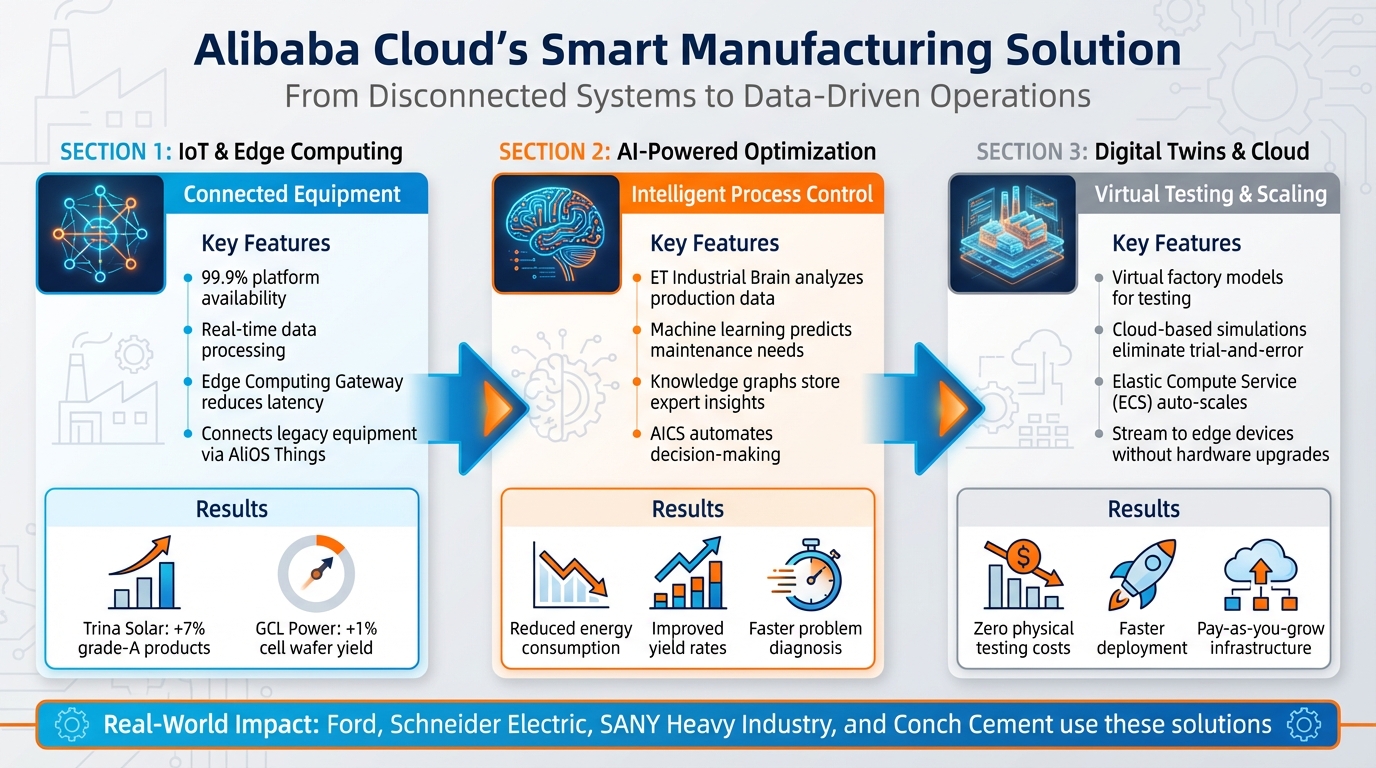
How Alibaba Cloud Transforms Traditional Manufacturing: 3-Step Solution Framework
Alibaba Cloud is changing the game for manufacturers by turning disconnected factories into streamlined, data-driven operations. By connecting equipment, refining processes, and enabling virtual simulations, it addresses long-standing challenges in the industry.
IoT and Edge Computing for Connected Equipment
Alibaba Cloud's IoT Platform centralizes the management of factory equipment across the globe, offering a 99.9% availability rate and secure device authentication. Through its Edge Computing Gateway, it connects machines, processes industrial data, and performs real-time computations to reduce network strain and latency. The Edge Node Service (ENS) plays a crucial role by cleaning and refining data at the source before sending it to the central cloud. For older equipment, solutions like AliOS Things and the End Device Access SDK ensure seamless connection and synchronization.
A practical example is seen at Chongqing Refine-Yumei, where automobile engine blocks are tagged with QR codes linked to real-time die-casting data, such as temperature and pressure. This setup allows workers to monitor operations closely and quickly spot defects. The data collected feeds into Alibaba’s Industrial Brain, which suggests optimal processing settings. This has led to measurable improvements, like a 7% increase in grade-A product ratios for Trina Solar and a 1% boost in cell wafer yield for GCL Power. Once devices are connected, AI steps in to turn raw data into actionable insights.
AI-Powered Process Optimization
Alibaba Cloud's DAMO Academy leverages machine learning to analyze production data, pinpoint quality issues, and predict maintenance needs. Its ET Industrial Brain acts as a central hub, linking production line data to recommend settings that enhance yield and lower energy use. Knowledge graphs store expert insights, making it easier to diagnose equipment problems and manage spare parts efficiently. Meanwhile, AICS automates decision-making by learning and adapting to changing conditions.
This system reflects Zhang Jianfeng's vision of data-driven resource allocation as a cornerstone of manufacturing. Companies like SANY Heavy Industry use Alibaba's data platforms to process vast amounts of information from their core systems, improving overall efficiency. Additionally, low-code development tools empower workers to create custom systems tailored to their factory’s specific needs. With these optimized processes in place, digital twins take manufacturing to the next level.
Digital Twins and Cloud Infrastructure
Digital twins allow manufacturers to create virtual models of factory floors, machinery, or products using sensor and camera data. These models let teams test production changes, troubleshoot equipment issues, and validate adjustments virtually - avoiding the costs of trial-and-error testing.
In November 2024, EKS InTec GmbH partnered with Alibaba Cloud to integrate digital twin solutions into Alibaba Cloud Workspace. This collaboration enables manufacturers to run virtual factory models in the cloud and stream them to edge devices for testing and training, all without requiring hardware upgrades. The rollout is scheduled for Germany and China by the end of 2024. As Holger Hämmerle, General Manager of EKS InTec GmbH, explained:
"By leveraging the power of cloud computing, we make it easier for manufacturers to access and deploy digital twins, enhancing operational efficiency and accelerating their journey toward smart manufacturing."
Conch Cement Co., Ltd. has already embraced this technology with its "Smart Factory 2.0", creating a digital twin of its production process. This includes milling and calcination in rotary kilns, where cloud-edge collaboration simulates optimal parameters. To handle the vast data generated by these simulations, Alibaba’s Elastic Compute Service (ECS) provides auto-scaling capabilities, ensuring the infrastructure keeps up with growing demands.
Case Studies: Companies Using Alibaba Cloud
Ford's Use of Elastic Compute Services

Ford has teamed up with Alibaba Cloud to drive its "In China, For China" strategy. By using Alibaba Cloud's scalable infrastructure, Ford can quickly roll out digital solutions tailored to the local market. This setup allows the company to better understand consumer preferences and behaviors, enabling them to deliver products and services at what many call "China speed." Robert Hou, Director of Mobility Platforms and Products at Ford Asia Pacific, shared his thoughts on the partnership:
"We are impressed by Alibaba Cloud's scalable and flexible technology and its strong ecosystem that enables us to rapidly deliver customized digital solutions for our Chinese customers. We value Alibaba Cloud's local market insights and reliable technology as it supports our 'In China, For China' strategy."
This shift is helping Ford move beyond traditional manufacturing, focusing instead on digital innovation to enhance mobility and connectivity. Other major companies are also turning to Alibaba Cloud for real-time data management and scalable solutions.
Schneider Electric's Move to Cloud Services

Schneider Electric has embraced Alibaba Cloud's "click and deploy" infrastructure to transition from a traditional equipment provider to an online service leader. By using Alibaba Cloud's Elastic Compute Service (ECS) with auto-scaling and Server Load Balancer, Schneider Electric can handle real-time traffic and adapt to growth. Additionally, Table Store is used to manage vast amounts of data. A Schneider Electric representative highlighted the benefits:
"Alibaba Cloud ECS's scalability ensures that our IT infrastructure can flexibly expand alongside our business growth. Alibaba Cloud Table Store offers a convenient and flexible storage solution to efficiently handle massive volumes of data."
This transformation highlights how Alibaba Cloud supports businesses in evolving their operations to meet modern demands.
Automotive Smart Workshops
Automotive companies are also leveraging Alibaba Cloud to revolutionize their production processes. Chongqing Refine-Yumei, for example, uses advanced QR code tracking and Alibaba Cloud's digital twin technology to optimize engine block manufacturing. Each engine block is assigned a QR code linked to real-time data - like temperature and pressure - from die-casting machines. This system helps workers quickly spot defects and improve efficiency.
In November 2024, EKS InTec GmbH integrated its digital twin solutions with Alibaba Cloud Workspace. This allows automotive manufacturers to access 3D visualizations of production plants for virtual commissioning. By streaming these detailed models from the cloud to edge devices, manufacturers can conduct training and operational testing without the need for costly local hardware. Dr. Ye Huang, General Manager of Central Europe Region at Alibaba Cloud, commented:
"Teaming up with EKS InTec GmbH marks a significant step forward in our mission to support smart manufacturing solutions. This collaboration will leverage the power of Alibaba Cloud's advanced technologies and global cloud infrastructure to enhance operational efficiencies and drive innovation in the manufacturing sector."
These examples demonstrate how Alibaba Cloud is helping businesses across industries modernize and innovate in their operations.
Conclusion: What Alibaba Cloud Means for Manufacturing
Alibaba Cloud empowers manufacturers to succeed in today’s data-driven environment. By integrating IoT, edge computing, and AI analytics, businesses can shift from simply reacting to problems toward optimizing processes before issues arise. For example, the Industrial Brain platform enabled Trina Solar to boost its grade-A product ratio by 7%, while GCL Power achieved a 1% improvement in cell wafer yield - all thanks to real-time data feedback and refined processing parameters.
With digital twins, manufacturers can run virtual tests to reduce waste and minimize downtime. Meanwhile, elastic infrastructure ensures companies only pay for the resources they use, scaling as needed. Edge computing further enhances efficiency by processing time-sensitive tasks locally, enabling quicker decision-making. These advancements not only improve operations but also strengthen global competitiveness.
Through the "China Gateway" program, Alibaba Cloud accelerates international market access. Ford leveraged this platform to deliver tailored digital solutions at lightning-fast speeds, while Schneider Electric transformed from an equipment provider into a leader in online services by utilizing auto-scaling infrastructure.
Manufacturers adopting cloud-native tools gain the agility to cut costs, adapt quickly to market demands, and stay ahead of the curve. As the CIO of SANY Heavy Industry aptly noted:
"In the long run, the next step for all companies is to be software companies."
Alibaba Cloud facilitates this shift to smart manufacturing, whether it’s optimizing a single production line or managing a complex global supply chain.
FAQs
What is ForthSource?
ForthSource is a platform built to streamline Alibaba sourcing for direct-to-consumer (DTC) brands. It brings together supplier information in one place, offering verified data, reviews, transaction records, and a Trust Score. This makes it easier for merchants to pinpoint dependable factories quickly.
Does it search other platforms?
Alibaba Cloud is designed to offer solutions specifically within its own platform and ecosystem. This means it does not provide support for conducting searches on external platforms.
How does the "Trust Score" work?
The "Trust Score" is a straightforward metric designed to help evaluate a supplier's reliability on Alibaba. It pulls together thousands of data points from the supplier's profile, including details like verified business licenses, transaction volume, response rates, and customer reviews. All these factors are distilled into a single score ranging from 0 to 100, offering a quick and clear way to gauge the supplier's legitimacy.
Can I calculate shipping costs?
With ForthSource's premium features, you can take advantage of the Real-Time Landed Cost Calculator. This tool helps you estimate shipping rates for air, sea, and express options. Plus, it calculates import duties and taxes, so you get a clear breakdown of the total product cost - all before reaching out to the supplier.
What is "Baidu Intelligence"?
Baidu Intelligence taps into domestic Chinese data sources to confirm a factory's legitimacy, going beyond the information available on its Alibaba profile. By utilizing insights from Baidu, China's top search engine, this tool provides an extra level of due diligence for businesses managing large-scale orders. It enhances verification efforts within China’s ecosystem by combining Alibaba's data with localized business insights.
How much does it cost?
Pricing details for Alibaba Cloud services are accessible through their billing portal. However, exact costs for services tailored to manufacturing aren't clearly outlined in the available materials. For precise information, it's best to visit Alibaba Cloud's solution pages or reach out to their support team for assistance.
Why not just search Alibaba directly?
Searching on Alibaba can feel like navigating a maze - there are sponsored ads everywhere, trading companies pretending to be factories, and countless unverified listings. ForthSource simplifies this process by cutting through the noise. It filters out unreliable options, offers verified supplier data, and assigns trust scores to suppliers. This makes it easier for merchants to spot trustworthy factories and make smart, confident decisions.